

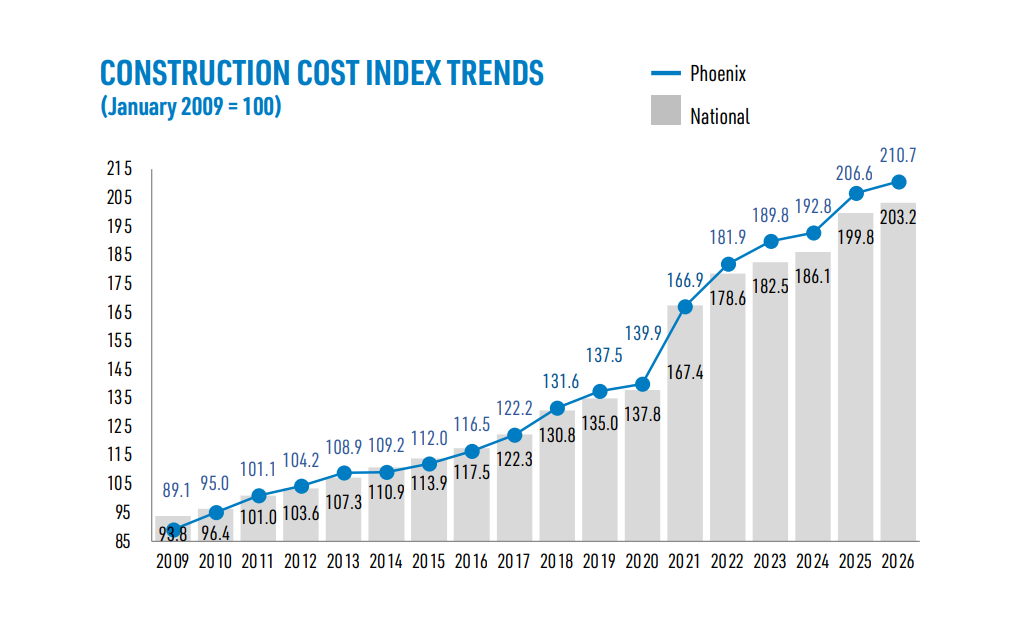

Even though construction costs in Phoenix were slightly higher than the national average, a newly released report shows they are continuing to moderate.
In its Phoenix Q1 2026 Cost Index, Mortenson reported construction costs in the metro area rose 1.97% over the quarter and 7.05% year-over-year. The company’s National Q1 2026 Index showed the average increase across the country was up 1.7% national and up 6.8% YoY.
Major drivers for the national increase were metal and energy costs, data center development disproportionately affecting supply chains and materials availability, and constraints on electrical and power distribution.
According to the national findings, “Nonresidential construction conditions remained generally stable through the first quarter of 2026, though cost escalation and procurement conditions continued to vary significantly by market and project type. While broader supply chains have improved relative to prior years, elevated metal pricing and continued demand tied to power, electrification, and data center expansion are sustaining pressure on select material categories and equipment availability.
“Market activity remains uneven across regions, with strong demand in large-scale infrastructure, manufacturing, and data center construction, and softer conditions in portions of the commercial and institutional pipeline. Planning activity remains elevated across key sectors, though momentum continues to vary by asset class.”
Mortenson’s index scored Phoenix at 210.7, while the national score was reported at 203.2. January 2009 serves as the baseline 100-point mark for the scale.
Citing U.S. Bureau of Labor Statistics data, Mortenson said metro Phoenix had 41,000 workers in Q1, up 3% YoY over Q1 2025. “Despite regional labor pressures, workforce conditions are stabilizing overall,” the report said.
Unlike recent data showing Multifamily starts struggling nationally—though Phoenix maintains a significant pipeline—Mortenson’s data shows other key sectors are performing well. (AZBEX; June 2)
According to the latest figures, construction starts have been rising, as has planning activity, in the Data Center, Healthcare, Energy and Infrastructure sectors. As of March, starts were up 13%. This upswing is also shown in the latest AIA/Deltek Architectural Billings Index, which ended the latest survey period closer to positive territory than at any time in almost three years. The indicator points to the possibility of a stronger development pipeline later in the year.
Cost Challenges Across Markets
Still, many regions across the country are facing challenges. Bidding environments are increasingly competitive as companies go after a tighter pool of traditional institutional and commercial opportunities. Though the supply chain has generally stabilized, as has labor availability, there are still significant constraints in steel and electrical scopes and in specialized trades.
Even with the current geopolitical challenges, supply chain and transportation networks are adapting and showing appreciable resilience in absorbing disruptions and pricing spikes. Ocean shipping is adjusting to altered routes.
Entering Q2, transportation and supply chain networks remain adaptable and more resilient than in prior years, allowing markets to better absorb disruptions and pricing volatility. Trucking costs continue to trend upward due to operating cost inflation and localized capacity constraints, while ocean freight is adjusting to longer transit routes. Ships and trucks, however, are facing higher fuel costs.
Adding to the pressures, tariffs and energy-associated costs are impacting prices on steel, copper, aluminum and electric power infrastructure. Long-lead electrical and distribution components are still tight in many markets, although most other materials have seen improved lead times.
Specific increases include a 4.1% rise in steel framing and stair erection, 3.8% in structural steel and metal decking, 2.8% for fire protection systems, and 2.7% in plumbing.
Looking at national trends, from Q1 2024 through Q1 2026, copper pipe has risen 41%, with copper wire rising 31%. Lumber increased 15%, while plywood was up 6%. Structural steel has risen 12%, and reinforcing materials are up 2%.
Other components have stayed flat or decreased. Conduit has experienced a 0% change over the two-year period, while steel pipe decreased 9%, and PVC pipe dropped 12%.
Conclusions and Projections
In wrapping up its Phoenix index report, Mortenson said, “The Mortenson Construction Cost Index reflects a construction market that remains active, competitive, and increasingly shaped by project-specific conditions as the industry moves through the second quarter of 2026. While select material categories—particularly metals, electrical infrastructure, and energy-related inputs—continue to face elevated pricing pressure, broader supply chain performance and labor availability have largely stabilized compared to prior years.”
It goes on to say, “Forward-looking indicators continue to trend positively, with planning activity, construction starts, and architectural billings showing early signs of renewed momentum. Taken together, these conditions point to a construction environment where outcomes are increasingly determined by how and where projects advance. Early planning, disciplined procurement strategy, and market-specific coordination remain critical to managing risk and positioning for opportunity.”