
By Roland Murphy for AZBEX
In a series of three identical 3-1 votes, the Cottonwood Planning and Zoning Commission recommended approval of a series of requests that will enable the development of a six-building, 252-unit apartment community southeast of the SEC of 12th Street and State Route 89A.
Owner and developer William Spring (as Forest Glen LLC) had requested a minor General Plan amendment from Highway Commercial to Residential/High Density, a zoning change from Single-Family/Multiple Family Residential and Heavy Commercial to Multiple Family Residential (R3), and a conditional use permit to exceed standard allowable building heights for his planned Spring Verde Apartments.
Part of the 8.8-acre combined site was once home to the Lumberman’s building materials and drywall supplier, which has been closed for several years. The property lies behind an existing bank and is located near a transit stop and several grocery and other commercial outlets.
Spring said he intends for the community to be the most highly amenitized in the area and noted the plan includes a clubhouse facility, a pool and pickleball courts. During questioning at the May 18 hearing, Spring assured the Commission access to the amenities is included in the rent and will be available to all residents.
He also stressed the development will improve the area’s walkability and is intended to serve both existing and soon-to-be-added workers in Cottonwood. Spring Verde will be marketed as a “walk to work” community to promote its convenient access to nearby employers, including the Verde Valley Medical Campus Cancer Center currently under construction slightly more than a mile away.
Spring cited housing studies and local industry reports noting a shortage of housing units and housing types in Cottonwood, along with an ever-expanding need as employment and in-migration grows.
The unit mix calls for 108 one-bedroom, 117 two-bedroom and 27 three-bedroom apartments. Rents are expected to start at $1,100.
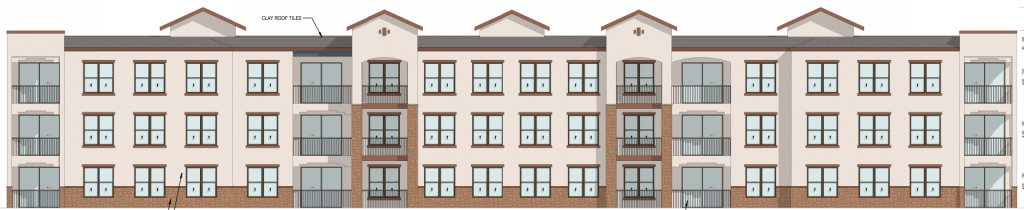
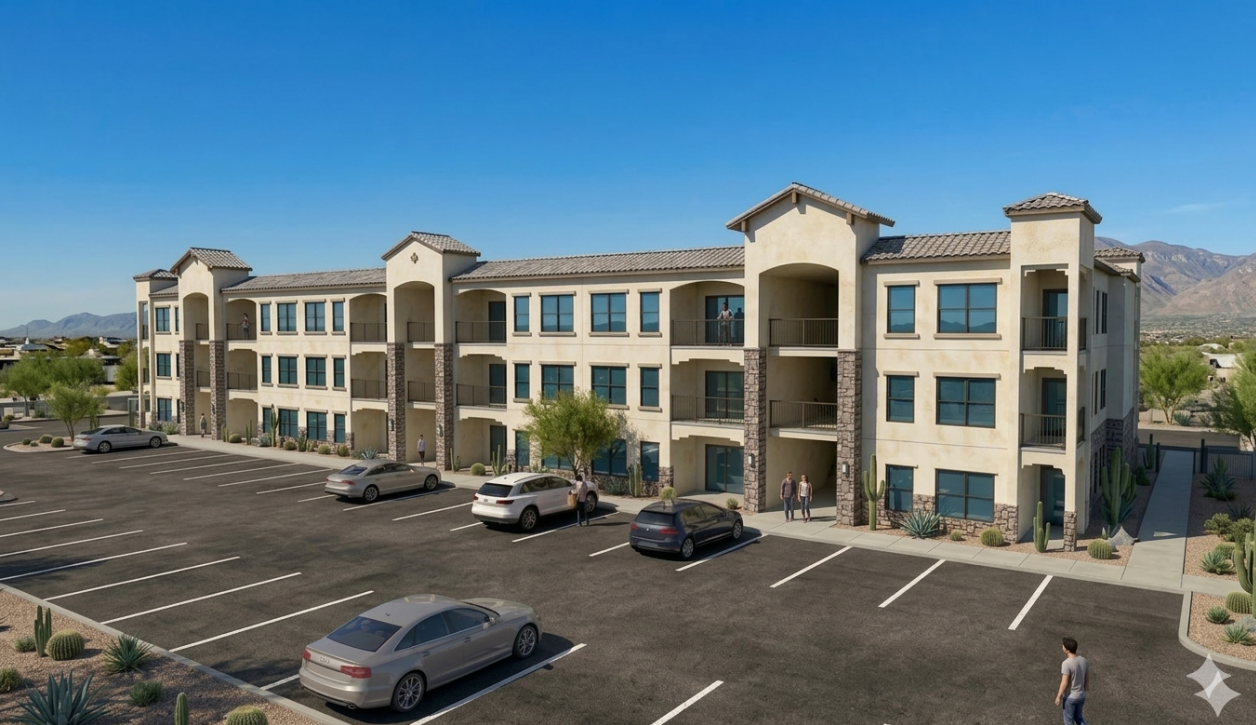
The property is on a sloped area, which will require a drainage study but will also, according to Spring and representatives of design firm CESO, minimize the visual impact of the three-story buildings when viewed from 12th Street.
Those visuals and their associated design elements, as well as density, traffic impacts, changes to neighborhood character and the perception multifamily developments lower property values, were among the points opponents delivered during the public comment portion.
The inclusion of tower-style design elements was one of the items necessitating the conditional use permit. While added to help conceal mechanical elements on the buildings’ roofs and to add differentiation to the façade, some members of the public and at least one Commissioner felt they make the structures look like a hotel development. CESO representatives and other Commissioners said any concerns about the towers could be addressed in a future design review.
When Commissioners were asked for their comments, questions and input, Commissioner Beth Canedy echoed some residents’ concerns about the density and raised the point there are several planned and approved multifamily developments in the area that have not yet been built.
“Although I’m not anti-growth,” she said, “I believe there is a time to catch up, like maybe we should take a reprieve. I know we’re not going to have a building moratorium, but there you have it.”
Chairman Randy Garrison said housing and infill, including projects like Spring Verde, were a major point of discussion and concern during the most recent General Plan update. He harkened back to a time when his home was the only one on 12th Street. “Everybody that’s moved into that area made my life worse by adding traffic to that street,” he quipped, earning a small degree of laughter from the attending audience. “Traffic is what it is.”
He went on to say the Arizona Department of Transportation will have to examine traffic volumes in the area and determine how to make improvements. “Today, all we’re truly doing is looking at taking a piece of industrial use property, as well as a piece of (residential) property and combining those… so that the developer can go in and do an infill project on a piece of property that has been, in my eyes, a blight for decades.”
He went on to say, “If you think 250 apartments across the street from you is a hazard or is going to be a noise problem, you weren’t here when Lumberman’s was there because I can tell you what it sounded like having trucks and saws going from six in the morning until six or seven at o’clock at night. Things change. We want to make them change appropriately and mindfully….
“I think we have to move forward and give the applicant the opportunity to come back with something that is appropriate not only for them but for the community. Hopefully, it will be done with the comments that have come from this Commission, as well as the comments that came from the public.”
Canedy was the lone vote in opposition when the three motions to recommend approval were made.
The plan will now advance to City Council for consideration.