
By Roland Murphy for AZBEX
The Public Works event in the BEX Leading Market Series is consistently one of the best attended every year, and 2026 proved to be no exception.
Nearly 150 people signed up to come to SkySong on April 14 and hear the latest project news and updates from two of the Valley’s most dynamic public bodies.
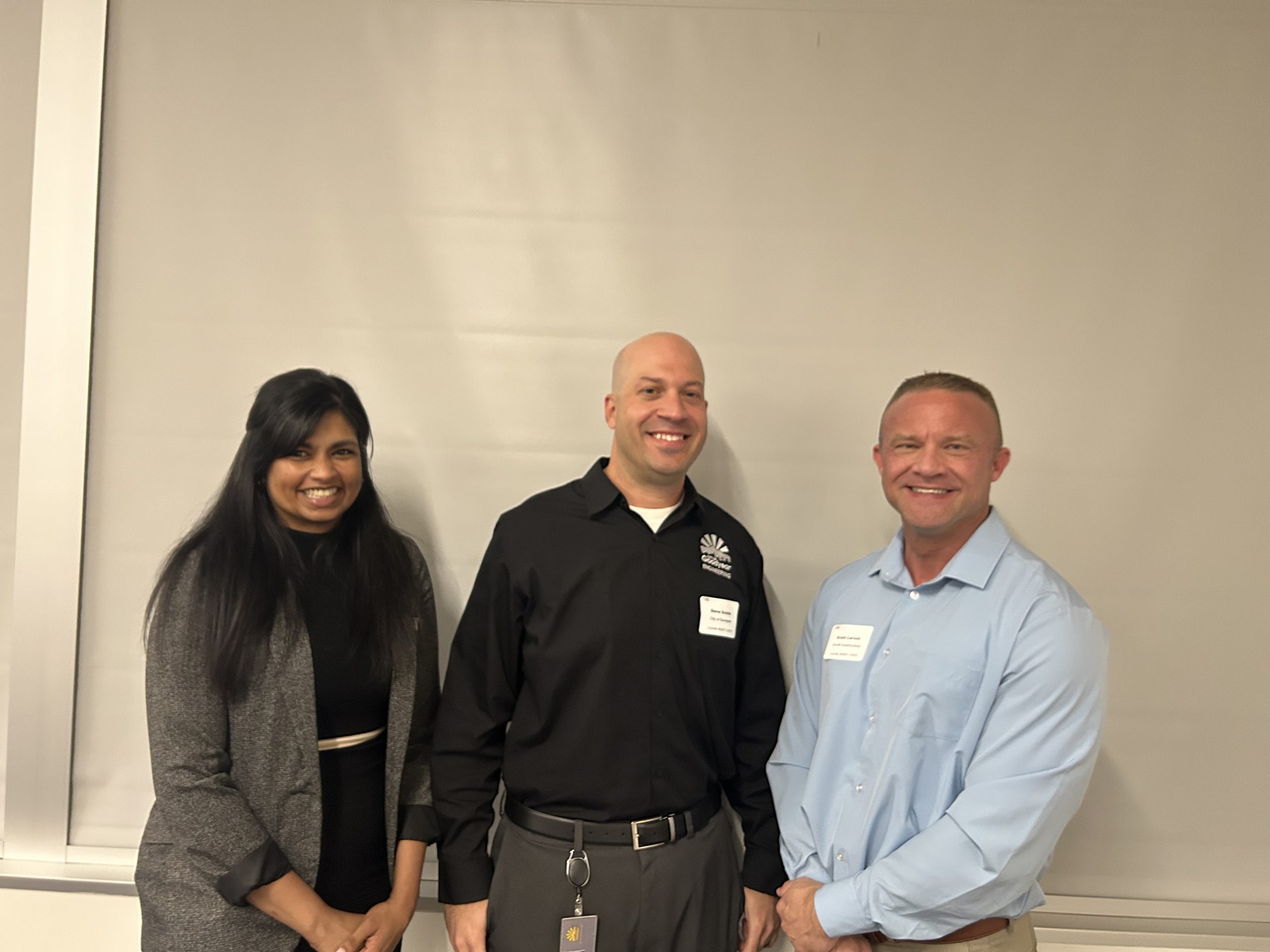
Following brief introductory remarks from BEX General Manager Bobby Raether, Grant Larson, Project Director at event sponsor Sundt Construction, introduced the day’s panelists: Goodyear City Engineer and Director of Engineering Steve Scinto and Maricopa Association of Governments Transportation Policy & Initiatives Manager Arminta Syed.
Anyone who may have been concerned about the event having only two presenting panelists had their worries laid to rest almost immediately, as both Scinto and Syed unleashed a wealth of program details and project specifics upon the audience.
Maximizing the presenters’ time in front of the audience, Larson started with a quick icebreaker and then dove straight into the presentations, introducing Scinto to speak first about Goodyear’s programs.
Goodyear Projects and Programs
Scinto began by discussing the City’s Capital Improvement Project process, including the newly implemented CIP 365 approach. Under CIP 365, Goodyear moved to year-round project submittals, which include monthly updates and strive to ensure quality at the source with project initiation and scoping that includes all the project’s stakeholders.
Including the stakeholders in the scoping process targets better budgeting and ensures realistic schedules, Scinto said, as well as providing more confidence in project deliveries under Goodyear’s roughly $1B CIP program.
He then gave updates and statuses on several key projects. Highlights from this portion of the presentation included:
- Estrella Parkway, Vineyard Avenue to MC85 (Estrella Bridge): A $114.4M project that is currently 95% through the design phase;
- Bullard Wash Trail Extension to Ballpark: Valued at $32.3M, this project will allow users to traverse the entire wash and go from Camelback to the baseball stadium without driving on a roadway, and
- Municipal Operations Complex – Fire Resource Management Building: A new facility valued at $34.5M and currently 20% through the design phase.
Turning to upcoming items for the City, Scinto spoke about Goodyear’s present impacting its future. A major ripple effect on transportation planning and projects revolves around accommodating the estimated 100,000 trips/week that will be generated by the new Buc-ee’s Travel Center, which is expected to open later this year. Two Interstate-10 interchange improvements that were originally envisioned for 2040 or 2045 will be moved up significantly in the development schedule, with more information expected next year.
Another item getting attention in Goodyear includes the City’s work on its Road Safety Action Plan, which is expected to go to City Council by the end of the year and will generate future development work to implement.
Scinto closed his portion of the session with an update about Goodyear’s Job Order Contracting program. Contracts under the updated program have a duration of three years, with two one-year renewals and caps of $5M/JOC, with a max of $15M/year.
MAG: Implementing Prop 479 Implementation
Syed came to the lectern with palpable enthusiasm to discuss the massive volume of projects and timelines taking shape as the voter-approved Proposition 479 transportation sales tax to-do list has gotten underway.
AZBEX was one of the state’s leading outlets in terms of covering the Proposition 479 approval process. Most of that coverage is available here.
Syed started her presentation with a background about the region MAG covers, which covers 27 cities and towns, three Native nations, two counties and 10,600 square miles, with a population of more than five million residents.
Implementation of Prop 479 is covered by the Regional Strategic Transportation Infrastructure Investment Plan, which was approved in 2021 and guides investments through 2045. Over the course of 20 years, the $28.2B investment plan is expected to cost $28.2B, with the sales tax serving as the major source and contributing $14.9B.
RSTIIP projects fall under one of four program headings: Freeway Life Cycle, Arterial Life Cycle, Transit Life Cycle and Competitive Programs.
Phase I of Freeway Life Cycle Programs under Prop 479 features 13 individual projects, including State Route 30: Loop 202-97th Avenue, which marks the beginning of the SR 30 connector project in the West Valley.
The FLCP Fiscal Year 2027 draft includes five notable project updates, including multiple major interchange improvements and new roadway development for SR 30: 97th Avenue to Dysart Road.
Another key planned project is US 60 (Grand Avenue) at Loop 303 and 163rd Ave, which recommends an ultimate system interchange at Loop 303 and a new grade separated interchange at 163rd Avenue to finally resolve a major portion of the Grand Avenue bottlenecking in the area.
Prop 479’s arterial roadway component features 91 defined projects across four planned phases. A key entry on this list is the construction of Lone Mountain Road between Loop 303 and Lake Pleasant Parkway, which will help serve the burgeoning growth experienced in the Northwest Valley since Taiwan Semiconductor Manufacturing Company began its initial development in the area.
The Competitive Programs are managed by MAG and implemented by local agencies. These include arterial rehabilitation and widening, non-motorized infrastructure, intersection improvements and implementation of emerging technologies.
Following the program and project overview, Syed went on to explain other developments and focuses MAG is working on, including an update to the regional Transportation Systems Management and Operations Plan. The update will focus on leveraging existing infrastructure and increasing available funding for regional operations with broad regional collaboration.
With little time remaining after the two extensive presentations, Larson followed up with questions. When asked what the presenters and their agencies need from the community to best fulfill their goals, Scinto responded partners need to “bring your best” in terms of ideas and collaboration. He also urged them to refer people to come to work for the City as either direct employees or as contractors to help expand the ranks of available talent.
Responding to the same question, Syed said MAG needs to see the development community bring its best efficiencies and creativity to project planning and to help the agency develop the best ways to present the multitude of complex projects in digestible and easy to understand manners that will resonate with stakeholders and the public.
EDITOR’S NOTE: The presenters gave details on approximately 40 projects over the course of the one-hour program. To maximize the value attendees receive from coming to the event in person, we are not listing all the projects in this article. For our readers who would like to see the full project suites discussed at this week’s LMS, the slide deck is available for purchase here.