

By Cushman & Wakefield
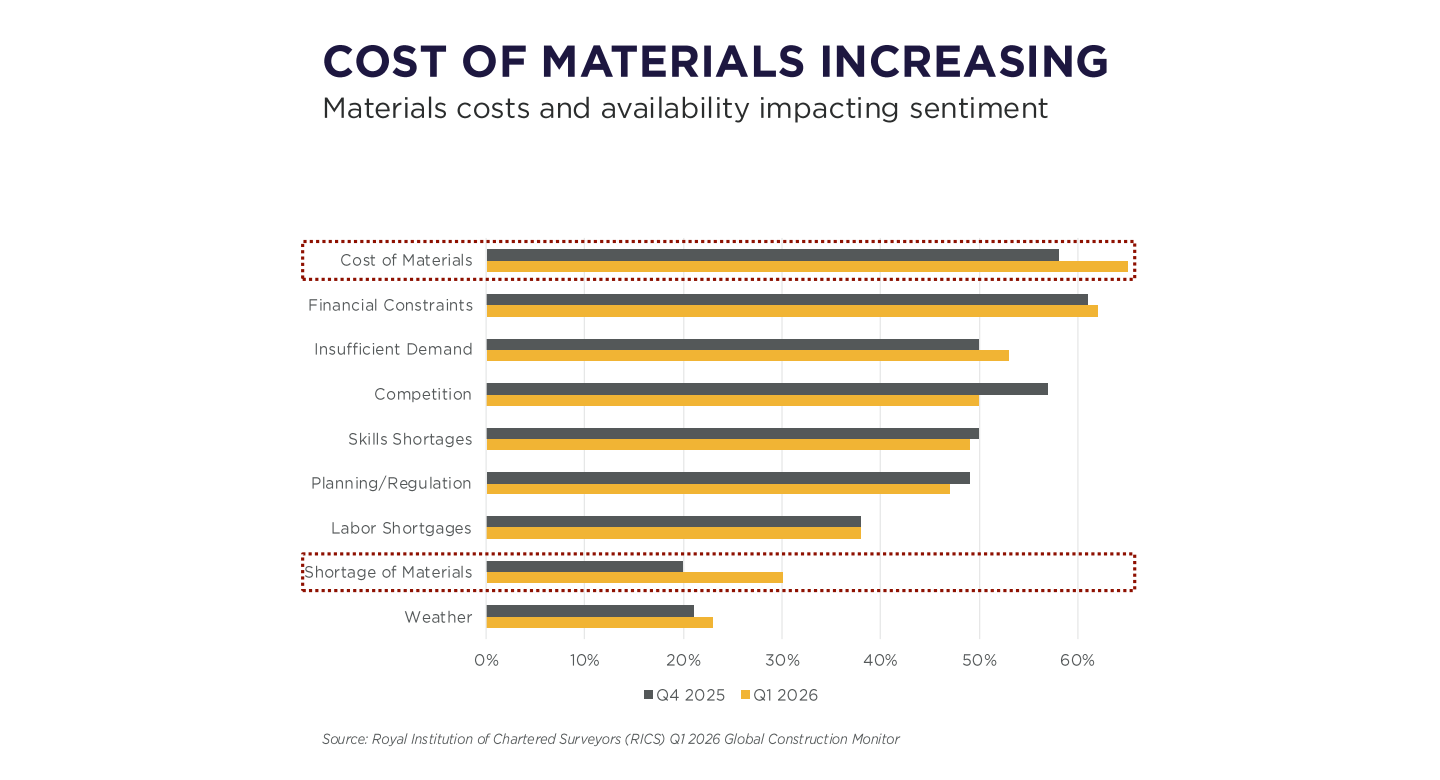
U.S. construction cost pressures are shifting from labor to materials, with construction-related commodity prices rising 13.3% year-over-year as tariffs, metals supply constraints and demand from data centers and infrastructure projects push input costs higher, according to Cushman & Wakefield’s latest Construction Insights for Global Occupiers report.
The increase in commodity prices is more than 4.7 times the rate recorded a year earlier, led by aluminum at 40.9%, copper base scrap at 39.3% and nonferrous metals at 38.5%. At the same time, labor cost growth has moderated, creating a markedly different construction inflation environment from recent years.
“The pressure on construction costs hasn’t disappeared, but its source is changing,” said Tyler Paytas, Global Head of Programs & Projects, Global Occupier Services at Cushman & Wakefield. “Labor remains constrained, particularly in specialized trades, but materials and equipment are increasingly driving escalation. For occupiers planning projects, that means the cost environment can remain challenging even as wage growth moderates.”
The ENR Building Cost Index increased 4.7% YoY in August, compared with a 1.5% increase in its skilled labor component. Overall construction materials rose at least 1.0% month-over-month for three consecutive months through August, with annual growth accelerating from 6.5% in June to 8.5% in August.
Electrical equipment is emerging as a particular pressure point. Electrical machinery and equipment prices increased 13.0% YoY, while switchgear increased 9.0%, reflecting demand from grid modernization, renewable energy investment and data center development. Transformer and switchgear costs are forecast to accelerate further through the end of the year amid continued copper supply constraints.
Data Centers Sustain Construction Activity as Broader Market Softens
The cost shift is occurring against an increasingly divided construction backdrop, with data centers and infrastructure projects supporting activity while many traditional commercial real estate sectors remain subdued.
Contractors working on data center projects reported an average backlog of 11.0 months, compared with 8.5 months among contractors without data center exposure. Infrastructure construction backlog reached 10.1 months in June, up 7.9% from a year earlier.
Meanwhile, commercial and industrial architectural billings registered 46.7 in June, below the 50 threshold indicating growth. Nine of the past 10 months have registered below 50, signaling continued weakness in the broader nonresidential construction pipeline into 2027.
The divergence is also contributing to greater volatility in national construction activity. New construction starts surged 33.5% month-over-month in May as major healthcare, manufacturing, utilities and data center projects broke ground, before declining 20% in June.
U.S. Cost Escalation Remains Muted, For Now
Despite rapidly rising input costs, overall U.S. construction cost growth has remained comparatively contained. Construction costs increased 0.7% from the fourth quarter of 2025, compared with 6.4% in South Korea and 3.9% in Germany.
Greater domestic energy production has helped insulate the U.S. from some of the energy-driven construction cost increases experienced in more import-dependent markets. However, Cushman & Wakefield expects U.S. construction prices to accelerate as higher materials and equipment costs increasingly flow through to project pricing.
Contractor pricing was up an average of 4.3% YoY as of June, including a 6.4% increase in concrete. Metro-level construction costs increased an average of 4.42% YoY during the second quarter, approximately 0.9 percentage points above the national producer price index for nonresidential structures.
Globally, supply chain pressures have eased from their April peak, but Cushman & Wakefield expects metals and equipment costs to remain elevated amid structural supply constraints. Infrastructure, energy and data center projects continue to drive construction activity, while development across many traditional commercial real estate sectors remains comparatively subdued.
The report is available to view here.