

By Cushman & Wakefield
Phoenix’s bulk warehouse sector has tightened up dramatically, moving from one of the highest-vacancy segments of the Industrial market to one of its tightest, according to new research by Cushman & Wakefield. Although more than 11MSF are under construction, the vast majority of that is already leased, illustrating the massive pent-up demand for this type of space.
Cushman & Wakefield’s new Bulk Blueprint report examines the performance and outlook for industrial buildings of 300KSF and larger across Metro Phoenix. As intense tenant demand meets a rapidly diminishing supply, the segment—representing 123.6MSF and 27.4% of Phoenix’s total Industrial inventory—is now leading the recovery of the broader Industrial market in Phoenix.
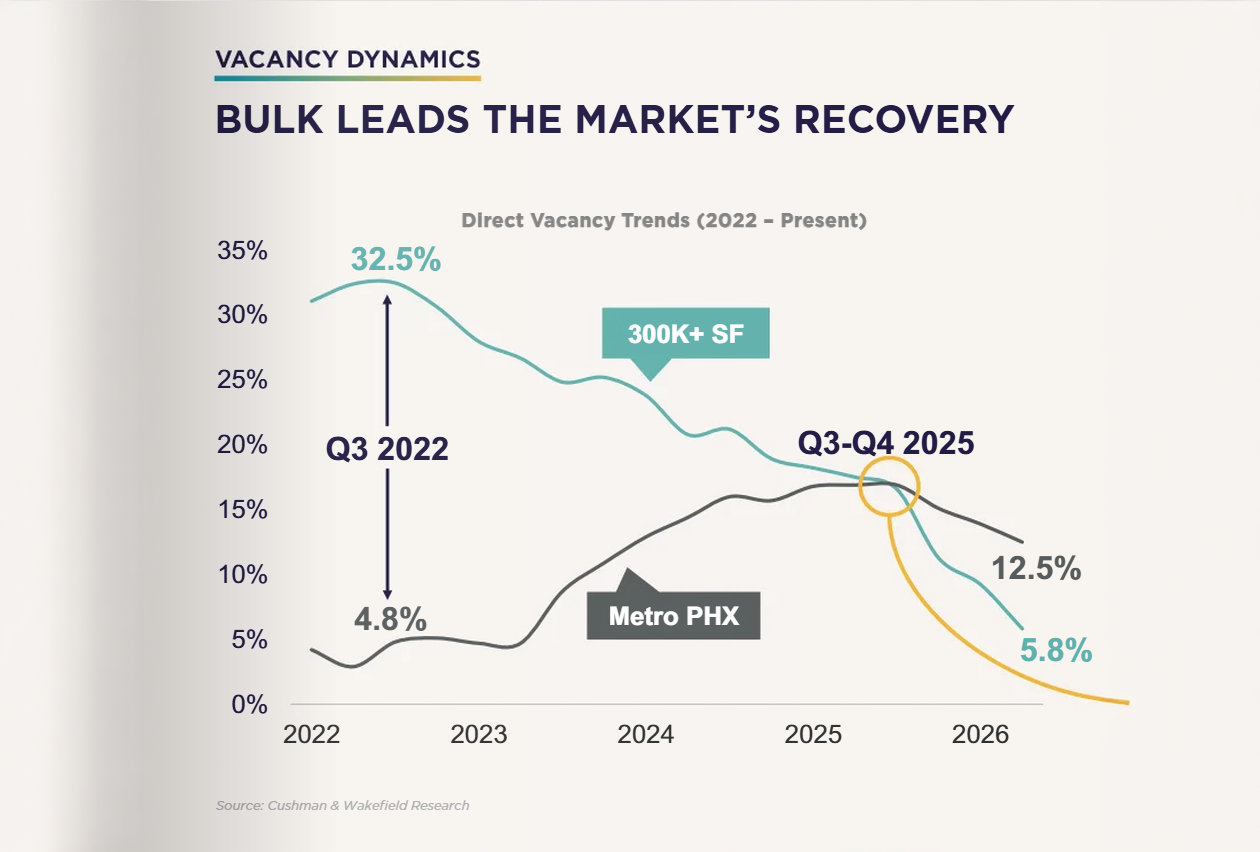
Phoenix’s bulk warehouse vacancy peaked at 32.5% in the third quarter of 2022, the product of three consecutive record years for construction. Since then, rising demand for large-format facilities and a sharp slowdown in new deliveries have driven vacancy in the segment to a cycle-low 5.8%.
Meanwhile, overall Industrial vacancy in the Phoenix metro peaked at a record 16.9% in the third quarter of 2025 before easing to 12.5% in the second quarter of 2026.
Demand Outstrips Available Supply
The imbalance between supply and demand is becoming increasingly pronounced. Since 2021, Phoenix industrial occupiers have committed to an average of 11.2MSF of bulk warehouse space annually through leasing and owner-user acquisitions. Space is being vacuumed up even faster this year: Through the second quarter of 2026, activity in leases and sales had already reached 8.3MSF.
At the same time, tenants are competing for a limited amount of existing space. Cushman & Wakefield researchers identified 34 tenant requirements for 21.5MSF, compared with just 10 existing facilities that represent 4.1MSF of available bulk warehouse space.
As a result, vacancy is expected to continue declining, and asking rents should face upward pressure as occupiers compete for a shrinking pool of options.
Three user groups—third-party logistics and distribution, manufacturing, and retail/wholesale trade—have accounted for 72% of bulk warehouse space committed from 2019 through 2026. These users are forecast to remain among the most active sources of demand, the report notes.
Construction Pipeline Has Thinned
Bulk warehouse vacancy is on track to continue declining, according to the report. New bulk warehouse deliveries fell from 19.2MSF in 2023 to just 300KSF through the first half of 2026.
There are 11.1MSF warehouse projects under construction in the metro area. However, approximately 78% of that space is already pre-leased, leaving a relatively limited amount of speculative product available to prospective tenants.
Phoenix’s expanding semiconductor and advanced manufacturing ecosystem is also contributing to demand for large-format warehouse space. These users require facilities to store, transport and maintain equipment, helping drive leasing activity for new projects.
Cushman & Wakefield expects the bulk warehouse segment to continue leading the Phoenix Industrial market’s recovery into 2027 and beyond.
With the gap between tenant demand and available space widening, the report identifies a growing case for new speculative bulk warehouse development. Occupiers with specific size, timing and technology requirements are also expected to increasingly consider build-to-suit solutions as existing options become more limited. (Source: Cushman & Wakefield)