
By Roland Murphy for AZBEX
The dominant theme and mood for the Arizona construction market heading into 2025 was uncertainty. Major changes in federal policies, expected shifts in population growth, nearly every economic indicator up in the air, increases in organized resistance to projects and a range of other trend factors made forecasting the sector’s direction in the year ahead as much an exercise in prognostication as informed projection.
A new theme emerged in preparing for the 2026 BEX Construction Activity Forecast Event: Resilience. Since the collapse of the Great Recession, the construction market in general—and the Arizona construction market in particular—has demonstrated a remarkable ability adapt to shifts in the wind and tack a course for growth and delivery.
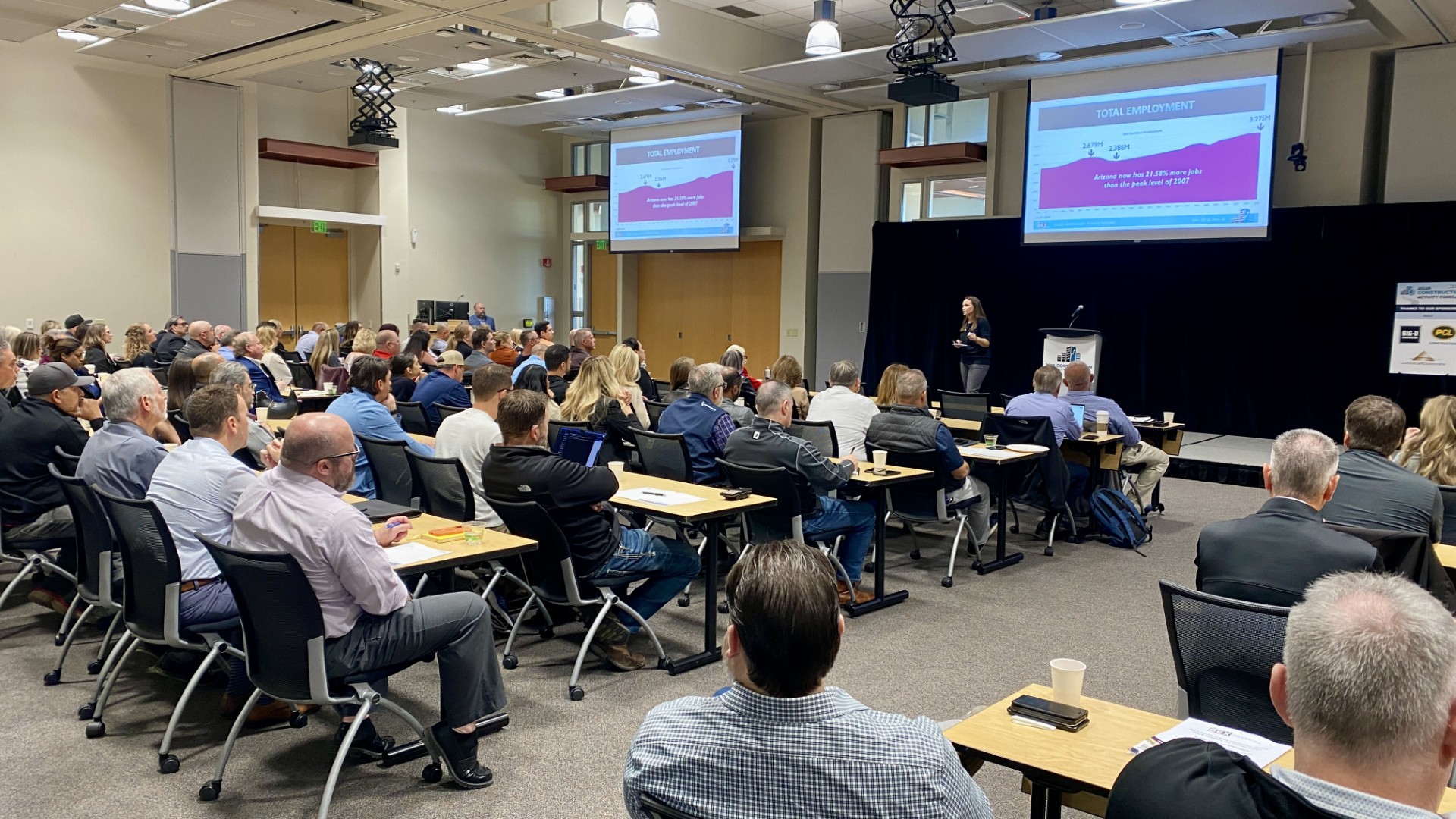
Once again delivered in two separate but identical sessions to accommodate the number of attendees, the Forecast Event gave BEX President and Founder Rebekah Morris and key members of the BEX Research Team—generally referred to as “The BEXperts”—a forum to distill major trends across the state for the core construction sectors.
As their primary ongoing duty, The BEXperts track projects across three primary sectors (Public Infrastructure, Housing and Private Development) and 10 core sectors (K-12 – Public & Charter Schools, Higher Education, Public Spaces, Transportation & Parks, Utilities, Housing, [Multifamily, Build-to-Rent], Industrial [Warehouse/Manufacturing, Data Centers], Healthcare, Hospitality, and Office & Retail).
Hundreds of new projects are entered each year into the DATABEX project database, and the thousands already input are updated. For The Forecast Event, all that data is scrubbed, dissected and analyzed to present the audience with comprehensive overviews of the total market and activity changes in each of its subsectors over the preceding 12 months, along with our best estimates of what can be expected in the year to come.
BEX General Manager Bobby Raether welcomed attendees and gave Move Over Bob co-founder and CEO Kate Glantz an opportunity to introduce her magazine and her organization’s vision for opening opportunities in the skilled trades for women and young people. Following Glantz’s brief comments and invitation for follow-up, Raether provided a process overview of how The BEXperts do what they do and set expectations for what attendees would see in the next two hours’ data dump.
And with that, the mornings were off and running.
State of the Market
Following Raether’s introduction, Morris took the stage to deliver her market summary of the major economic factors driving Arizona construction. As has become her stock in trade with this presentation, she covered the key factors of Population Growth, Employment, Inflation, Cost of Capital (Interest Rates), Regulation and Tariffs, and Funding Uncertainty.
In her introduction to the economic factors, Morris told attendees the key takeaway over 2025 was the uncertainty the market faced at this time last year was met with an exceptional degree of resilience across the majority of the market. Most specifically:
- Federal funding for infrastructure via executive orders did not kill projects;
- Local government got creative to ensure and maintain capital funding, and
- Markets have adjusted and continue to move forward.
Following her statements on resilience, Morris dove into the economic driver data attendees have come to expect. Starting with population growth, she pointed out that, after several years of maintaining a growth rate of around 1.5%, the rate dipped in 2024 and held in 2025 at around 1.27%.
Total employment in Arizona continues to hold to a generally upward trend over the last several years, reaching a total of 3.275 million jobs in 2025. That number dipped slightly from 2024, but the state is still reporting 21.58% more jobs than its previous peak in 2007.
At 223,500 jobs to close out 2025, construction employment remains strong. Still, reflecting the now-ever-present theme of “doing more with less,” the sector is still down 7% from its previous peak in 2006.
Not including 2020, which shall forever be considered an asterisk in economic data sets, construction employment generally increased between 5% and 10% year-over-year between 2016 and 2024. In 2024, it fell roughly 1%, which Morris referred to as “functionally flat.” The sector rebounded in 2025, however, going up 3.42% by year-end.
Estimated construction activity for 2025 was calculated at $25.7B, showing the market has roughly doubled in volume since 2016, even after adjusting for inflation.
Looking back to assess how the reality of 2025 compared to the BEX forecast, Morris reported a prediction of $29B for a year that actually showed an estimated $31.9B. Much of that disparity was attributed to the fact many more data centers were announced than originally envisioned, along with the unexpected announcements of massive expansions to the Taiwan Semiconductor Manufacturing Company and Amkor campuses.
It is also worth noting the complete Construction market total includes single-family residential, which is not a sector BEX tracks as part of its standard industry reporting.
Another item of uncertainty has been the way federal infrastructure projects are now handled. The current administration has brought much more flexibility and confusion into what will be built, when and by whom, with less precise structuring and departures from traditional procurement and, with that, reduced ability to track and report.
The Market Sectors
Following Morris’ overview, she, DATABEX Manager Lya Parrish and Market Researchers Andrea Howard and Jaden Schneider dove with both feet into their reviews of each of the primary market sectors.
Each of their presentations was filled with data and nuances about trends and happenings, along with shifts in both the overall sector and individual projects. In the interests of space and maximizing the value received from attending the event, we are limiting our coverage to just the key data points for the sectors, their players and key projects.
K-12 and Charter Schools
- Top Project: Tolleson High School #8 ($180M);
- Top Owner: Tolleson Union High School District;
- Top Design Firm: DLR Group;
- Top GC: Chasse Building Team;
- Projected 2026 Construction Volume: $773.5M.
Higher Education
- Top Project: McCain National Library ($167M);
- Top Owner: Arizona State University;
- Top Design Firm: BWS Architects;
- Top GC: McCarthy Building Companies;
- Projected 2026 Construction Volume: $480.4M.
Public Spaces
- Top Project: Douglas Commercial Land Port of Entry ($325M);
- Top Owner: City of Phoenix;
- Top Design Firm: Jones Studio;
- Top GC: Hensel Phelps Construction;
- Projected 2026 Construction Volume: $1.4B.
Transportation & Parks
- Top Project: U.S.-Mexico Border Wall Tucson and Yuma Sectors ($606M);
- Top Owner: ADOT (Arizona Department of Transportation);
- Top Design Firm: Kimley-Horn & Associates;
- Top GC: Sundt Construction;
- Projected 2026 Construction Volume: $3.2B.
Utilities
- Top Project: SunZia SW Transmission Project ($1.5B);
- Top Owner: City of Phoenix;
- Top Design Firm: Water Works Engineers;
- Top GC: Sundt Construction;
- Projected 2026 Construction Volume: $2.32B.
Multifamily (Apartments/Condos)
- Top Project: Center Complex Project ($400M);
- Top Owner: The Empire Group;
- Top Design Firm: Todd & Associates;
- Top GC: Layton Construction
Build-to-Rent
- Top Owner: Dominium Apartments;
- Top Design Firm: Felten Group;
- Top GC: Lifestyle Homes;
- Projected 2025 Combined Multifamily Construction Volume: $6.8B.
Industrial (Warehouse & Manufacturing)
- Top Project: TSMC Fabs 1-6 ($30B – adjusted for equipment & machinery);
- Top Owner: TSMC;
- Top Design Firm: Ware Malcomb;
- Top GC: Okland Construction.
Data Centers
- Top Project: Project Baccara ($3B);
- Top Owner: Takanock;
- Top Design Firm: Corgan;
- Top GC: Holder Construction;
- Combined Projected Industrial and Data Center Construction Volume: $11.55B.
Healthcare
- Top Project: Mayo Clinic Expansion ($1.9B);
- Top Owner: Mayo Clinic;
- Top Design Firm: SmithGroup;
- Top GC: Okland Construction;
- Projected 2026 Construction Volume: $723M.
Hospitality
- Top Project: Cardinals Training Facility & Team Headquarters ($200M);
- Top Owner: Arizona Cardinals;
- Top Design Firm: Gensler;
- Top GC: M.A. Mortenson Company;
- Projected 2026 Construction Volume: $1.12B.
Office & Retail
- Top Project: TSMC Main Office Building ($247.5M);
- Top Owner: Vestar;
- Top Design Firm: SmithGroup;
- Top GC: Okland Construction;
- Projected 2026 Construction Volume: $962M.
Conclusions
When the individual sector reports were finished, Morris thanked her fellow presenters, the Research team, the attendees and the event sponsors before delivering her conclusions and parting thoughts.
These included a hat tip to 2025 for showing that, while difficult challenges remain, they are not insurmountable. She also highlighted:
- Growth is still happening, but it is uneven;
- The federal government really should follow contracting rules for procurements;
- The trend of announcing groundbreakings (and holding ceremonial groundbreaking events) for projects that are not even entitled, permitted or that do not yet even have a contractor in place confuses accurate timeline reporting, and
- With all the unknowns, shifts and question-raising practices, processes and events currently impacting Construction as an industry, critical thinking and precision questioning are more important now than ever.
Morris closed the event, as per usual, with BEX’s best estimate of overall activity for the next three years. In 2026, the data indicate Arizona Construction will see a volume of $31.1B, followed by $35.5B in 2027 and $39B in 2028.