


Like pretty much every market that wasn’t high-volume Industrial or Data Centers, Build-to-Rent Multifamily ran into headwinds in recent years, fueled largely by an earlier mania to build and market conditions like high interest rates, capitalization difficulties and general inflation.
Then, at the start of this year, political wrangling in the Senate over the 21st Century ROAD to Housing Act threatened to kill the sector outright. Fortunately, an amendment that would have forced institutional owners to sell off portfolio homes one-by-one to individual buyers was killed before the Act’s final passage.
Those months of uncertainty, however, acted like a brick wall, an anchor and any other impeding cliché one might like to use when it came to new BTR projects being proposed, both in Metro Phoenix and across the country.
Maricopa County/Metro Phoenix is generally considered one of, if not the, birthplace of the BTR sector, and the market was consistently among the most active in the country. In 2017, the first full year for which the DATABEX project database has details, there were two projects. 2018 saw nine. There were 13 in 2019.
After that, the market exploded. DATABEX added 32 BTR plans in 2020 and jumped up to 52 in 2021, before slowing back down to 31 in 2022 and just 12 in 2023. 2024 reported only eight, while 2025 had seven. So far in 2026, DATABEX has added five, three in the first quarter before the legislative panic took root, and two in the last two months since fears have abated.
Northmarq’s Latest Data Shows a (Possible) Leveling Out
Northmarq recently published its Q2 2026 market report for metro Phoenix BTR. According to the highlights, “After several years of elevated development, the Greater Phoenix BTR market is moving into a slower phase of the supply cycle. Deliveries have fallen sharply in 2026, leading to vacancy improvements in recent periods, although rents have not yet begun to gain momentum.”
Rents ended Q2 down 1.7% year-over-year, reaching $1,969. Vacancy dipped 100 basis points over the past six months to land at 8.8%.
Investment activity has been particularly interesting. Northmarq reports only a handful of properties traded in the first half, but prices have increased 25% over 2025’s numbers, ending Q2 2026 with an average per-unit price of $430K.
Particularly worthy of notice is how BTR is maintaining its position between traditional apartments and for-sale single-family homes. Kidder Mathews’ most recent data shows an average per-unit cost for apartments at $266,672, while MLS data shows the average sale price for single-family homes to be $607,310.
Of course, luxury home sales, which have remained comparatively healthy, can inflate averages, which is why many reports use the median instead. Interestingly, the median Phoenix home sale price according to Redfin was $455K. Zillow reported an average home value of $408,770.
As was seen with traditional multifamily, the building boom in the first half of the decade swelled deliveries, which contributed to the current pipeline slowdown. According to Northmarq, “Current operating conditions in the Phoenix build-to-rent market reflect the cumulative impact of three years of elevated construction during a period of fairly steady renter demand for units.
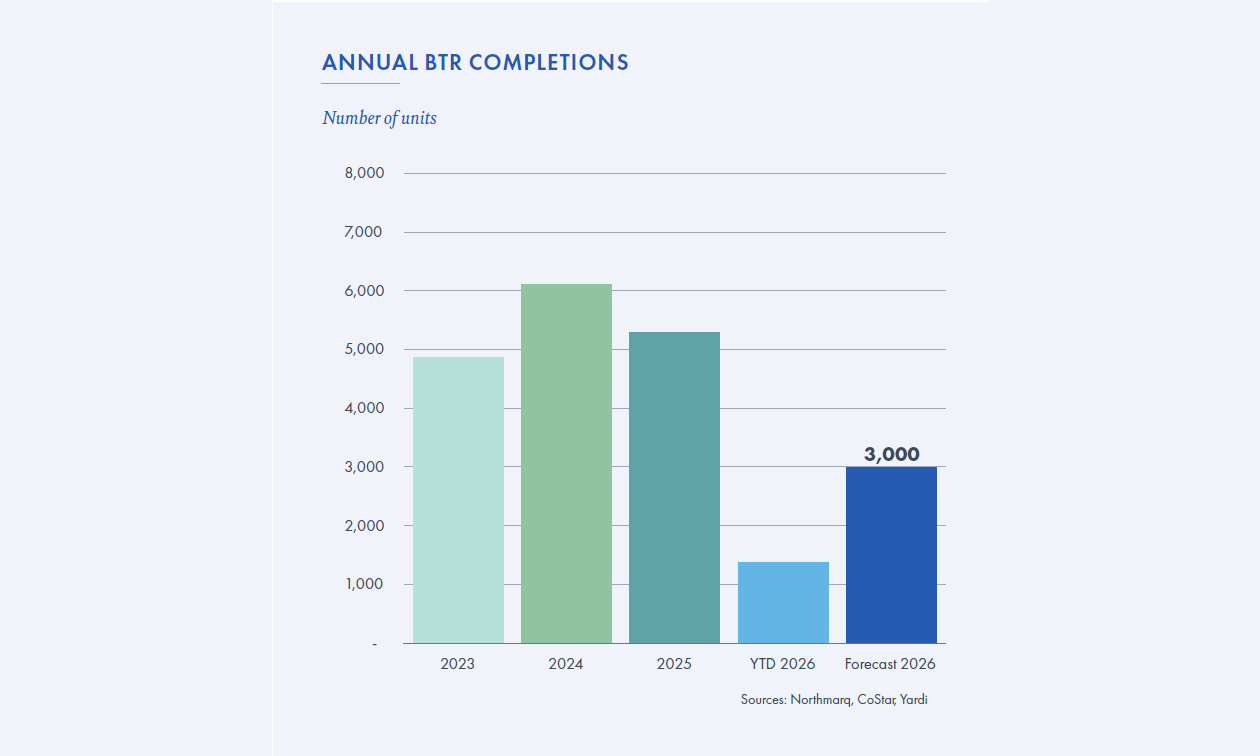
“Area BTR developers delivered an average of more than 5,000 units annually from 2023 through 2025, nearly tripling the region’s inventory over that stretch. Construction has since slowed sharply, with fewer than 1,400 units delivered through the first half of this year, while the development pipeline has thinned. The recent decrease in completions is giving room for vacancy to improve, and the recent pullback in new supply suggests pressures should continue to ease.”
Northmarq’s data would indicate the earlier building boom has largely run its course. The firm reports slightly more than 5,000 deliveries in 2025 and fewer than 1,400 through Q2 2026, with most coming in San Tan Valley and Maryvale. The report projects another 3,000 units will be delivered by year-end.
With that said, Northmarq reports 3,640 units under construction in Metro Phoenix. If that is the case, then supply/demand parity might be fairly close on the horizon. In theory, if all the stars align, there could be one more reason to expect new projects to pick back up after 2027.
DATABEX’s data, which is individually assembled by BEX research staff on a project-by-project basis, matches Northmarq almost exactly. The database shows a total of 3,689 units under construction across 18 developments.
While multiple sources can all be incorrect, the likelihood of completely different research and data collection methods yielding results that match nearly identically is low.
While nothing in commercial real estate and residential development are ever completely smooth sailing, between our data and Northmarq’s, more even seas may be on the horizon.