

Following several months of planning and stakeholder meetings, owner Mack Real Estate Group’s application to amend the Planned Unit Development zoning for 3,721.6 acres in the Halo Vista master plan at the NWC of Interstate 17 and Loop 303 was scheduled to go before the City of Phoenix’s North Gateway Village Planning Committee on Oct. 8, after this issue went to press.
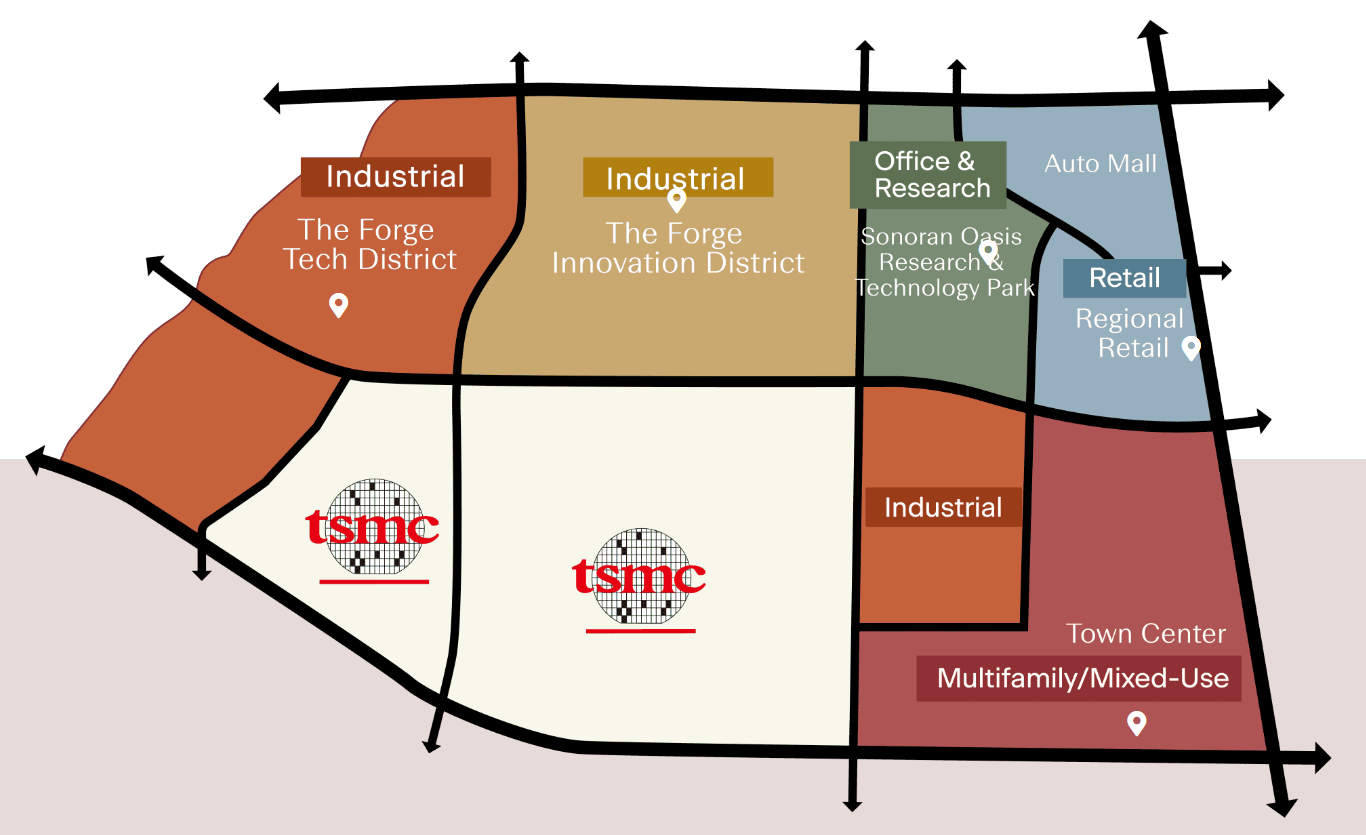
Halo Vista is an expansive master planned area that surrounds the Taiwan Semiconductor Manufacturing Company’s primary campus on three sides. The overall planning vision includes industrial, office, hotel, retail, residential and other mixed-use development. MREG purchased the initial site in 2024 through the Arizona State Land Department auction process and is overseeing development at Halo Vista in association with McCourt Partners.
The initial zoning and development agreements were approved in late 2024, and an official ceremonial groundbreaking to begin infrastructure work was held in March 2026.
The PUD amendment now moving through Phoenix’s review process would refine the development types and terms across the Halo Vista area.
The amendment application is comprised of nine primary topics:
- Expand the Automall,
- Allow Higher Education/Trade School uses,
- Increase residential heights in the mixed-use areas,
- Allow Commerce Park/General Commerce Park uses,
- Adjust how open space is calculated,
- Allow Battery Energy Storage System uses,
- Adjust noise levels in the Tech Campus/Park,
- Add three trees to the permitted list and
- Create a new signage package.
The Automall expansion would add a small area immediately west of the originally designated Automall portion at the property’s NEC and allow motor vehicle sales and leasing in that portion of the mixed-use commercial area.
As has been reported in AZBEX and other outlets, De Rito Partners recently paid $67.38M for the 130 acres in the Automall area. Seven dealerships have committed to the project: Courtesy Automotive Group, Berge Auto Group, Bill Luke Automotive, Potamkin Automotive, Findlay Automotive Group, Sands Automotive Group and Coulter Automotive Group. The project will include 11 lots. Three are still available. (AZBEX; Oct. 6)
De Rito Partners will complete infrastructure and site preparation, while the dealers will build their dealerships. The first dealerships are expected to open in 2028.
Higher education and trade school use restrictions would be removed in a generally square area connecting to a 2,640-foot-deep east-west area in the northeast of the property and a 2,500-foot-wide north-south area just west of the Automall and mixed-use residential area. The overview notes the current restrictions are based off setbacks for Ben Avery and 43rd Avenue. Higher education and trade school uses are specifically prohibited in the existing language. The amendment would change the language to allow them in the exempted area.
Under the request, the current building height limit of 60’/five stories for residential uses near the Automall and commercial area would be increased to 120’ for an area north and south of Dove Valley Road.
A 2,500-foot-wide area immediately east of the TSMC campus and west of the residential component would see its standards changed to include all the allowable uses under Commerce Park and General Commerce Park zoning.
The open space calculation request would replace the current requirement, which calculates the necessary open space based on individual project/development units, with a method calculating the determination by land use district, such as freeway mixed-use and tech park, and keeping a “running total” of the overall dedicated open space.
BESS uses would be allowed in the 2,500-foot-wide area immediately east of TSMC and in a large, vaguely L-shaped area immediately northwest of the campus.
Noise levels, as measured from arterial streets, would not be permitted to exceed 73 decibels as a daily average. A noise level of that intensity is considered a loud, urban environment, comparable to a busy freeway.
The requests would also add varieties of oak and elm trees, as well as red push pistache trees, to the landscape palette and create a Master Sign Program in the PUD to establish a framework and guidelines for future sign request processing.