
By Tasha Anderson for Arizona Builder’s Exchange
It’s October, which — in the world of public projects — means the Capital Improvement Plans are out for public viewing, and municipalities are planning for another fiscal year of new construction, expansion and maintenance. It’s also time for the third annual AZBEX Public Works Conference, where attendees gather to gain insight into the public sector and network with industry professionals.
More than 200 attendees gathered at the DoubleTree by Hilton in Tempe on Thursday, October 18th, for an afternoon of looking into the current and future state of the public sector… and of course, happy hour.
Here are some of the highlights of the afternoon’s program.
Top Capital Programs and Public Sector Outlook
AZBEX President Rebekah Morris kicked off the afternoon by diving into an overview of the public sector, including the top Capital Improvement Programs and a procurement analysis for Arizona.
Morris analyzed projected capital spending data from Fiscal Year 2013 through FY2018 and beyond to discover that capital spending is increasing, is likely to keep increasing, and that publicly funded construction has grown in importance to the overall Arizona construction market.
Morris then gave attendees a rundown of the Top 10 Capital Improvement Plans. City of Phoenix took the top spot with a $5.6B total plan, knocking the Arizona Department of Transportation’s plan out of the number one spot to number two at $4.9B.
After digging into each of the Top 10 agencies’ CIPs and highlighting new projects added to each, the conclusion was that there is a shift in the types of projects that were added; there are more vertical buildings than transportation and water and wastewater projects, and there is a continued focus on the maintenance of existing buildings rather than expansion.
Morris ended the segment by discussing current market conditions from procurement data analysis. She noted the number of individual contract opportunities is not drastically changing from year to year, but bid prices were increasing.
“The bid prices are coming in over, and sometimes significantly over, the engineer’s estimate,” she said.
Water and Wastewater
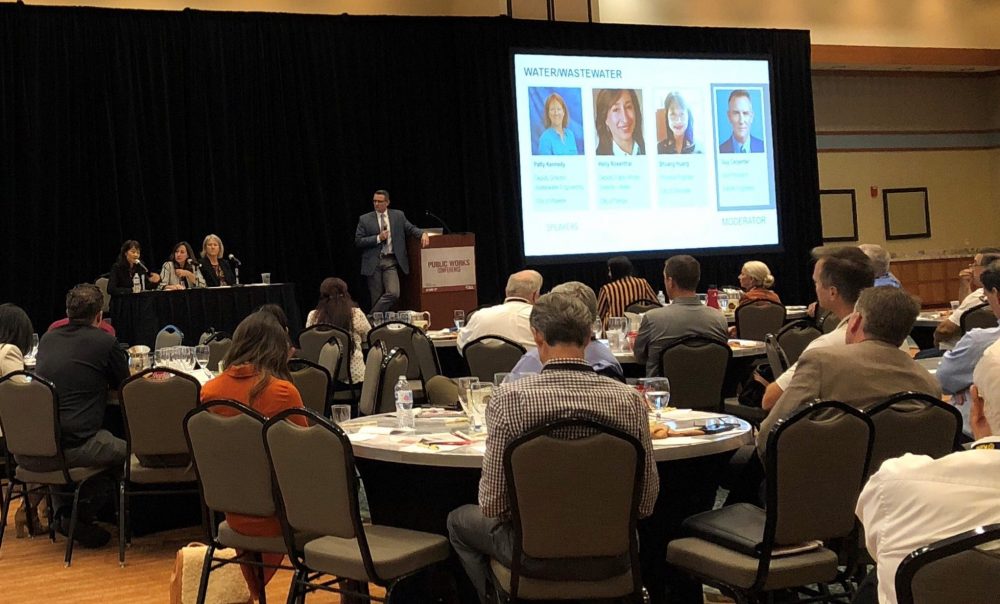
After the first segment, Morris introduced panelists, Patty Kennedy, deputy director of Wastewater Engineering with the City of Phoenix; Holly Rosenthal, deputy public works director with the City of Tempe; and Shuang Huang, principal engineer with the City of Glendale, along with Carollo VP Guy Carpenter as the moderator, to discuss the Water and Wastewater market sector.
Each panelist discussed ways their municipality is planning for long term water needs, including projects for rehabilitating and replacing aging infrastructure.
Kennedy discussed increasing the City of Phoenix’s well program by adding 15 new wells and the possibility of rehabilitating or replacing pipes around the city.
“We have pipes in the ground that are over a hundred years old, so as our infrastructure ages, we need to really look at a replacement or rehabilitation program,” said Kennedy.
Rosenthal noted the City of Tempe’s asset management program and discussed the city’s way of keeping up with improvements to their water/wastewater plants.
“We’re building a more robust asset management program. We’re being more strategic. We’re being more methodical. We’re using a continuous improvement cycle of assessment of our assets, prioritization of the capital programs, implementation, then we do it all over again,” she said.
Huang noted ongoing improvements to the City of Glendale’s water treatment plants, including $25M in improvements toward the Pyramid Peak Water Treatment Plant noted on the city’s Capital Improvement Plan.
The panelists also discussed the importance of having programs in place to meet future water needs.
“We need to make sure we have a good public perception… an industry is not going to want to move into an area where we don’t have an assured water supply, so we’re not going to drive industries to come to this area if we have the looming fear of water shortages,” said Kennedy.
“We need to remain mindful of how we use water,” explained Rosenthal. “We need to be conscientious with our water conservation programs and make sure they’re robust and communicate and educate ongoing into the future.”
Ports of Entry
Luis Ramirez Thomas, president of Ramirez Advisors Inter-National, shared with attendees the ongoing issues at the Ports of Entry, in particular, the lack of space, the need for building modernization and to relieve traffic congestion at the border.
Thomas discussed the plan for a Two-Port solution at the Raul H Castro Port of Entry, which would modernize the existing facilities and relocate commercial traffic to a new facility.
“We’re two years into this and probably have another five or six years to go before that solution becomes a reality.”
Thomas also noted a need to modernize downtown Nogales due to the increase in traffic and pedestrian delays and the 40 percent decrease in retail.
“To modernize this, we’re looking at probably $300M-$400M if not more,” he said.
Thomas discussed more issues with poorly constructed infrastructure but hinted that there would be a lot of potential business opportunities for some attendees.
Quick Hits
The City of Chandler and the City of Mesa provided attendees with a brief account of what’s been going on and what’s coming up in their areas.
Kim Moyers, downtown redevelopment manager for the City of Chandler discussed how downtown Chandler has grown and highlighted upcoming projects like the Oregon Street Parking Garage, which was approved by city council on October 18th and is expected to break ground on October 31st.
Rob Kidder, assistant city engineer with the City of Mesa, discussed the addition of a nearly $200M CIP bond package to the November ballot and the plans for the bond.
If approved, some of the projects to come out of that bond are:
- Construction of six athletic fields
- Park amenities and shared-use paths
- Cultural improvements
- Public safety improvements
According to Kidder, $111M will go to Parks and Cultural while $85M will go toward Public Safety.
Planning and Funding Transportation Projects
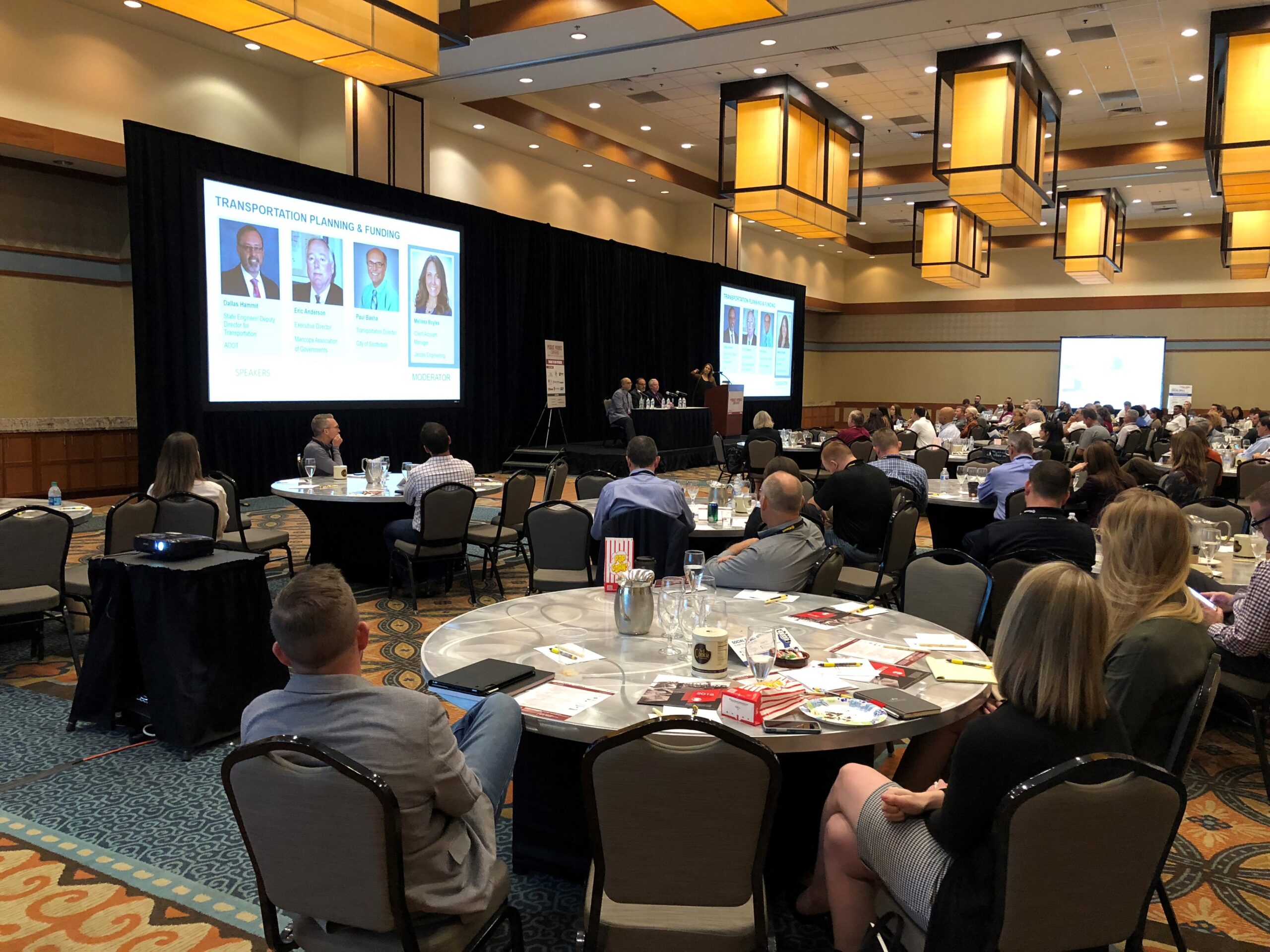
The transportation panel of Dallas Hammit, state engineer/deputy director of the Arizona Department of Transportation; Eric Anderson, executive director of Maricopa Association of Governments; and Paul Basha, transportation director with the City of Scottsdale, along with moderator Melissa Boyles, client account manager with Jacobs Engineering, took the stage to discuss long-range planning for transportation projects.
One of the key takeaways from the segment was dealing with unforeseen growth and how transportation always has to think long-range.
“We need to be agile…Transportation is always long-range,” said Basha. “We always have to think five to 20 years into the future. With land-use planning, developers, they measure their long-range planning in weeks… we can’t be entirely concerned about today, we have to consider the future.”
With regards to funding, Anderson noted the potential of increasing money for projects by increasing the gas tax, and how that tax has been sitting at 18 cents per gallon and hasn’t increased since 1991.
Another major takeaway was the importance of new technology when it comes to collaborating across State, Regional and Local levels. The panelists all agreed the use of social media was key because it helps them get an idea of how to prioritize their needs and helps spread the word about public comment dates and in-person meetings. They also believe keeping the old methods of communication like in-person comment periods is important because it keeps the public informed.
Developing and Delivering a Value Statement to Owners
The last panel of the afternoon discussed how firms can do business with owners and what the agencies are looking for during the procurement process.
Panelists, Ginger Spencer, public works director for City of Phoenix; Susanna Struble, assistant town engineer/CIP manager for the Town of Gilbert; and Monica Perrin, senior project manager for Arizona State University, with moderator Patrice Miller, managing partner with RH Associates, took the stage to give attendees insight into what each of them are looking when selecting a firm for a project.
“We’re looking to you guys to say how can you think; how are you thinking, and how would you address any challenges that you see?” explained Struble. “We really want to have confidence as you move forward not only in the proposal process, but into the interview, that we are going to trust somebody that is able to carry that way from beginning through end of the project.”
“Bring something concrete,” said Perrin. “Teach us something about our project that we didn’t know… it shows us that you’ve done your research, and that you really do understand the challenges and how you can actually make this project better.”
“Own up to your mistakes,” said Spencer. “Reach out to the customer and make sure that you have a clear understanding of what the expectations are.”
The panelists were also in agreement that, in order to build a relationship, they want to get to know the company, and they encourage firms to come in and visit and to get on their annual RFP lists.
The next AZBEX conference, January 10th, is all about forecasting construction activity for the next few years. Visit http://forecast.azbex.com/ for conference details or to register.