
By Rebekah Morris for AZBEX
On Tuesday, March 10, the City of Phoenix Aviation Department hosted its annual Aviation Business Summit, attended by hundreds of industry professionals eager to work on airport projects. The most compelling of the upcoming work, arguably, is the future $4B West Terminal project at Phoenix Sky Harbor International Airport that has recently been accelerated by years.
Daver Malik, assistant aviation director and chief development officer for the City of Phoenix, spoke on the topic, highlighting the reasons the airport needs to plan and expand for future growth, how it plans to build the largest program in the airport’s history on an actively operating airport, and what opportunities are available for the design & construction community.
Malik spoke about the sustained passenger growth at the airport, which is well documented as passenger counts have reached 52M per year. Beyond record passenger counts, Malik also pointed out travelers are more likely to originate or terminate in Phoenix, and the planes airlines use are getting bigger. Those two factors are leading to increased space requirements at terminals, curb and circulation spaces. The airport is projected to hit 68M passengers/year by 2038.
PSHIA and the City of Phoenix have not been sitting idly by while passenger counts rise. Rather, massive improvements to terminals 3 and 4 have been underway for years. These include the S1 Concourse at Terminal 4 (completed in June 2022) and the more than $350M worth of projects currently under construction at T3 N2. Malik described these capital investments as “incremental improvements” to the airport. These projects take the existing terminals 3 and 4 as far as they can. There is no more space to expand them, and the next phase of expansion will be the new $4B West Terminal.
The West Terminal project is still in early planning stages, with more questions than answers about the final plan. Malik described the potential size as being able to support either 62 narrow body contact gates or 16 wide body gates, or some combination thereof. Officials are acutely aware of both the need to integrate the new terminal into the existing plan and circulation of the airport, and how impactful the project will be to the region when completed.
Enabling Projects
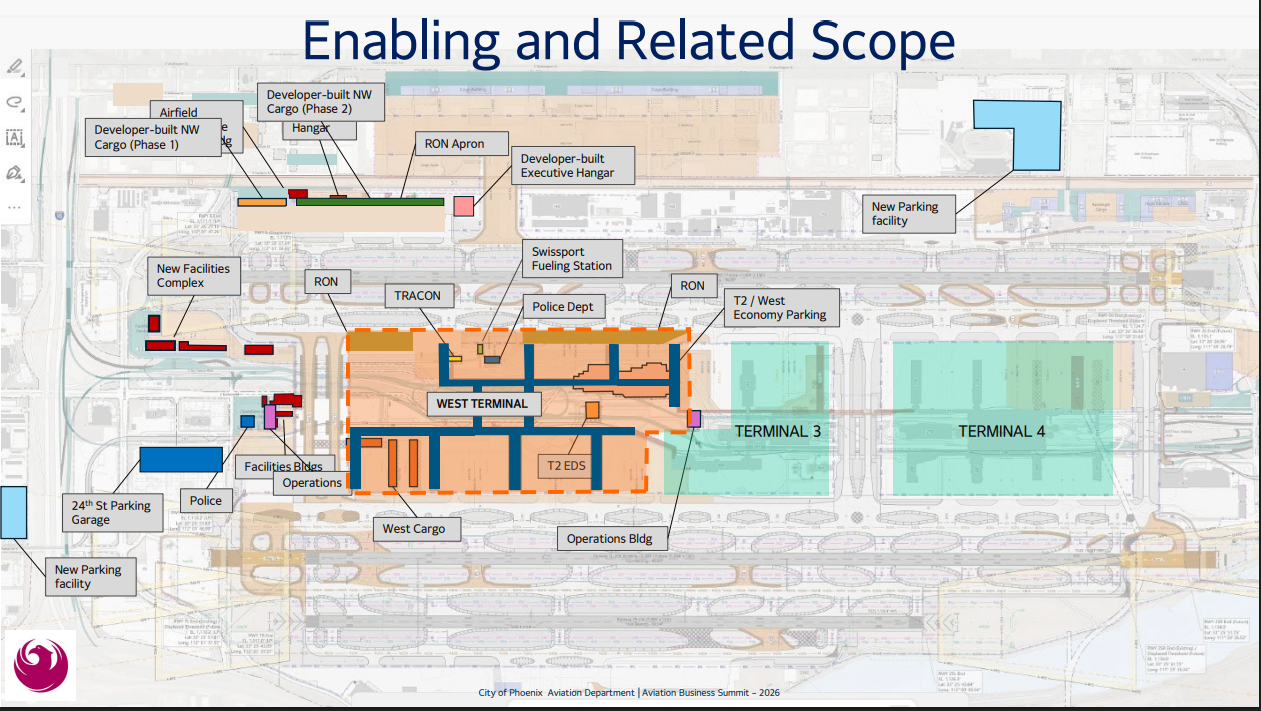
“There is no such thing as a greenfield project at Sky Harbor,” quipped Malik. To that end, a long list of enabling projects must be carefully planned and sequenced to make room for the West Terminal. Some of the projects mentioned include:
- New Facilities Complex
- T2 EDS/Baggage Handling/PD
- Terminal Radar Approach Control, also known as TRACON
- Cargo Developments – existing privately owned facilities on airport land must be redeveloped elsewhere and tenants must be moved
- Executive Terminal
- Build Parking that will be displaced
- Demolish T2 West Economy Parking Garage
- Relocate EDS
- Swissport Fueling Station
These enabling projects are currently being sequenced and procured, with completion required before the West Terminal can begin construction.
Accelerated Schedule – Construction May Start in 2029
In December 2025, the Federal Aviation Authority announced PSHIA did not need to prepare another Environmental Impact Statement before moving into planning for the new terminal building. Instead, FAA determined the EIS from 2006 had sufficient detail and was acceptable to move forward with the West Terminal project. That decision accelerated the overall program’s schedule by approximately three years: a 2032 construction timeline has been moved up to 2029.
The project began planning activities in earnest last month and is expected to have a planning initiative called a Program Definition Document completed by the end of the year. That PDD will set the basis for design, and procurement of a prime design firm is expected in 2027. A contractor is also expected to be selected in 2027, although Malik said there is no decision yet on the contract method of delivery—whether it will be CMAR, Design-Build, or Progressive Design-Build. Malik said such a large program will require intensive coordination, implying that a low bid was not currently being considered.
Malik concluded his presentation by noting the effect this program will have on the area. He described it as “impactful,” having regional significance, and said it will be an asset that serves the community for the next 40-50 years.