

By CJ Jorgensen for AZBEX
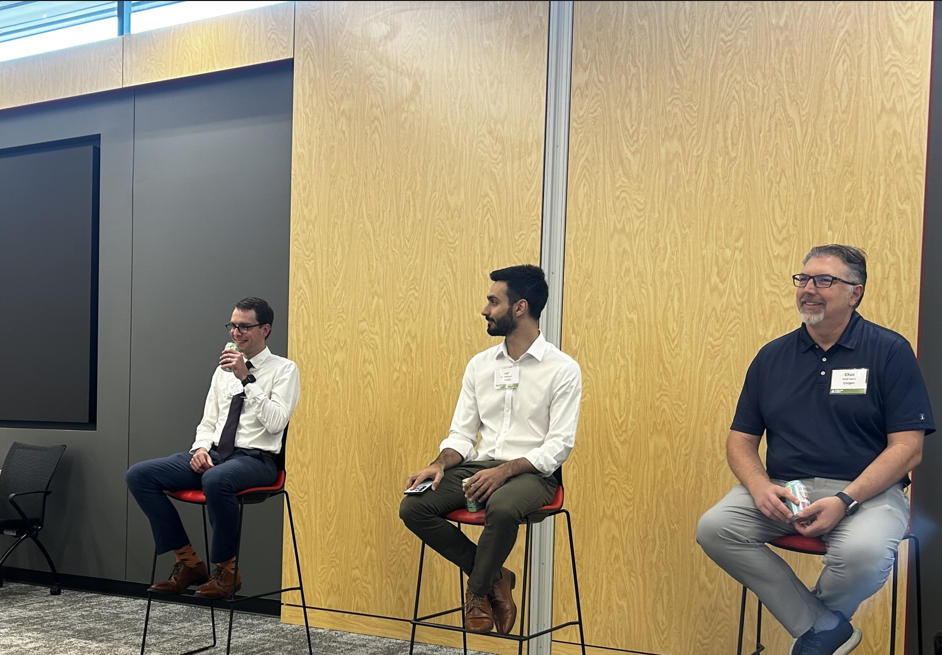
Earlier this week, ULI Arizona hosted “From Foundation to Finish: AI in Real Estate and Construction” at Sundt Construction’s training center in Phoenix.
The event focused on the ways in which artificial intelligence can be applied to design/construction, as well as the common pitfalls using AI in the industry can fall into. The three speakers on the panel were Eric Cylwik, director of innovation at Sundt Construction, Jad Chalhoub, director of business analytics at Rosendin and Chad Speas, VP and director of practice technology at Corgan.
Prior to taking audience questions, the speakers shared how AI has helped them with their individual roles. Cylwik spoke of being on-site in Salt Lake City and wanting to test if AI can explain certain things on a construction site.
He took a photo of an orange tarp on the construction site and asked it the question, “What is the orange in this picture?” Within seconds the AI was able to determine and explain that the tarp was a concrete curing blanket and listed reasons why it was there.
Cylwik explained that AI can be a tool to answer specific questions employees may have. “We have a way to engage people with an interactive, on-demand tool that gives them the knowledge that they need when they need it. They don’t need to feel silly for asking questions that are perfectly valid and normal,” he said.
Chalhoub went on to explain that not all AI is generative AI, meaning that not all AI spits out text or images to answer prompts. His team was able to use AI to develop a risk assessment tool.
This risk assessment tool is designed to be a red-light/green-light system. They use it to scan all their documents, and if an undesirable trend is present, the AI will flash a red light.
The light system doesn’t tell the user what specifically is wrong, simply that something is. Chalhoub claims that this tool has alerted them to projects that ended up less profitable than projected. This tool needed to be fed years of data to work properly.
Currently, Chalhoub’s red-light/green-light system runs off trends that are more or less likely to lose money; if the data shows trends that indicate it would lose money, the red light pops up.
If the system flashes red, the information is given over to the risk assessment team who then sort through the data to figure out what caused the issue.
When asked if AI will be able to provide a specific and substantial explanation of why it chose to show a red light, Chalhoub was optimistic that it will eventually be able to. “I think that eventually Amazon, Microsoft, Google or maybe OpenAI is going to figure out explainable AI. They’ve been at it for seven years now. It’s anybody’s guess. They tell us it’s next quarter every quarter. I’ll take their word for next quarter.”
Chalhoub said he wanted his big takeaway to be to “expand your vision of what AI actually is and what we can do outside of easy generative AI ‘give me my business plan’ kind of applications.”
Speas gave an example of using Chat GPT 4.0 to sort through spreadsheets. The AI program was incredibly fast at correlating and cross-examining information off questions based on the data within the spreadsheets.
Speas said that AI has many uses on the business side of things. From a designer’s perspective, it can help with design exploration, reality capture, model building and more. From a general business perspective, the summarization offered by AI can help improve efficiency.
Spreadsheets and AI can be used to easily determine trends. The example Speas used was applying baseball stats in a spreadsheet to determine the likelihood that a player would be able to hit a home run in the next game.
AI can use a recording of a conversation to summarize or even provide a transcript.
How AI Learns
Chalhoub explained AI learning as a neural network for image recognition. Once an AI sees a plethora of images, it will begin to be able to find patterns and commonalities between large portions of the data.
The more layers there are, up to a certain point, the better the AI gets at learning. Once there are too many layers, the computing quality of the AI can deteriorate. Being able to understand the amount of information an AI needs to run successfully is an important step toward using it efficiently.
Re-training AI is also an important step in maintaining positive results. For example, Chalhoub’s red-light/green-light system is re-trained every six months. While the AI they use is trained from the neural network, it also requires fine-tuning from the staff.
How to Engage AI
Speas gave the advice that the best way to work with AI is to almost treat it like a human. That’s not to say that it can be used to completely replace a human being, but rather that it may require multiple explanations to understand something.
It’s perfectly fine to tell AI it’s wrong – and AI being wrong is one of its biggest dangers. Speas said it would take him about nine-12 calls and responses to the machine to get the results he wanted.
Cylwik expanded on AI’s inaccuracies by pointing out the importance in how the question is phrased to the machine. “If you ask it a dumb question, you’re going to get a dumb answer. You have to be smart enough to know it’s a dumb answer.” He described AI as not a shortcut, but a tool to engage and inspire curiosity.
Chalhoub described how Chat GPT works by saying it turns words into numbers, a code, and looks at correlation. It doesn’t understand anything. He proceeded to pull out his phone and ask Chat GPT “How many Rs are in ‘strawberry’?” Chat GPT responded in a confident-robotic voice saying, “There are two Rs in ‘strawberry.’”
Chat GPT simulates an understanding by training off data. There’s no real understanding – just a simulation.
As Chat GPT codes words into numbers, it can only point out trends surrounding these numbers. Chat GPT used to only look at the next word, now it compares the previous words as well as the future ones.
AI needs someone to properly steer it to work correctly. Without a human guiding and checking it, it will very quickly get things wrong. The importance is to find where AI fits as a tool and not try to use it as the solution in everything.
AI in the Future
It has been seen that AI is being used to support communities with low access to certain resources. Cylwik gave the example of using an AI for medical services. In the U.S., if you’re concerned about a mole you can go to a dermatologist and get it looked at. In other places, that’s far more difficult, but it’s easier to take a picture of it and submit it to Chat GPT to get an idea of if it is dangerous or not.
While an AI isn’t as useful as a human in this situation, it’s far better than nothing.
Chalhoub warned that there are leaks that OpenAI is raising the prices of Chat GPT to $2k a month saying, “No one has ever sold something cheap that is actually worth it. Two grand a month, I expect it to start automating a bunch of things.”
Chalhoub hopes AI will eventually be able to rid workers of the need to perform menial, repetitive tasks and allow employees more time to focus on harder, more thought-provoking work.
Cylwik referenced a book called, “The Second Machine Age,” which talks about the concept of a general-purpose technology. It has taken 30 years from the introduction of new technology for it to have actually impacted businesses in a substantial way, and it’s going to continue to do.
One of Cylwik’s hopes is that AI will be able to use a design and intent to create a version in a particular style, facilitating a conversation and enabling a streamlined conversation between a designer and contractor.
Speas hopes AI will eventually be able to allow him to easily look at other options for materials while simultaneously being able to weigh the sustainability of the project and costs.
Closing Remarks
Speas said he’s frequently asked about the AI experts he works with. He claims that there are no AI experts, but rather AI champions. He recommends finding people with a strong interest in AI and getting them together.
Chalhoub stressed that AI is not human. It cannot pick up on human body-language cues or understand how people truly work. AI will never be able to be human.
Cylwik noted it’s useful for everyone to get some experience with AI. Even if it’s just using Chat GPT for fun and recreational use, it can always be helpful to have a base-level understanding of new technologies.