
U.S. Customs and Border Protection plans to install secondary border wall components parallel to the existing structure along the border with Mexico.
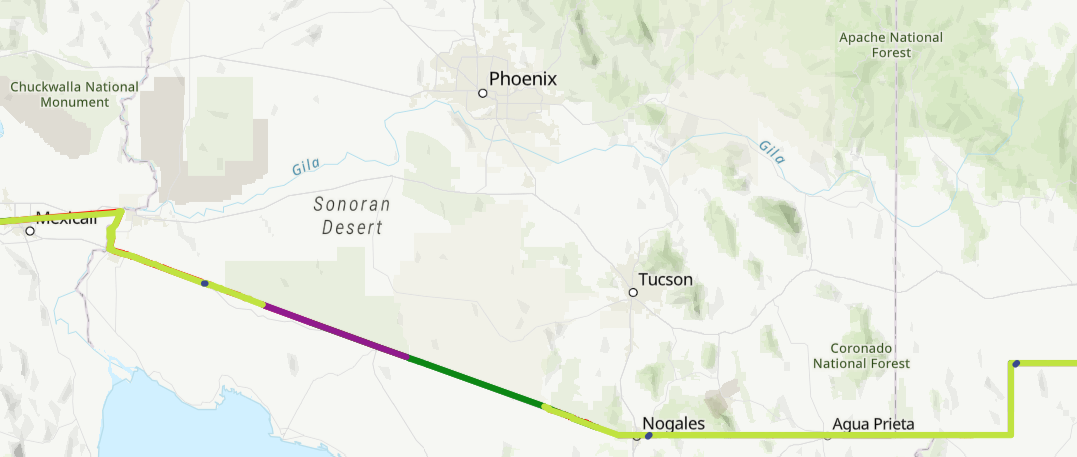
The agency’s interactive map shows seven projects planned for Border Wall 2 construction. The components are in various stages of execution, with some already under construction.
The first project, referred to as Yuma 2, is under construction and has more than a dozen separate segments covering nearly 52 miles of territory from San Luis to the Cabeza Prieta National Wildlife Refuge.
A contract has been awarded for the 22.5-mile Tucson 1 component stretching from eastern Yuma County to the Cabeza Prieta National Wildlife Refuge. Tucson 1 has an estimated project cost of $607M.
A contract has also been awarded for the $1.5B Tucson 2, which covers five widely distributed areas over 19 miles from the Baboquivari Mountains to Guadalupe Canyon near the border with New Mexico.
The remaining four sections are still in planning. Tucson 3 will cover 71 miles from the Coronado National Memorial to Guadalupe Canyon.
Tucson 4 is planned in five segments and totals 63.4 miles that stretch from the Pozo Verde Mountains to the Coronado National Memorial.
Tucson 5 is planned for 43.7 miles, reaching from the west side of Pima County to the Sierra de Santa Rosa at the south of the Ajo Range.
The last project, Tucson 6, is planned for both primary and secondary wall construction covering 63.3 miles of Tohono O’odham Nation land reaching from the Sierra de Santa Rosa to the Baboquivari Mountains.
As with the original U.S.-Mexico Border Wall development, the expansion and reinforcement effort has garnered significant opposition.
Rights activists have questioned the need for a second wall. The Tohono O’odham Nation has repeatedly come out against wall construction on its Tribal lands, and environmental groups have expressed a broad range of objections, including ongoing and potential new damage to environmentally sensitive areas, endangered animal habitats, unique water features and long-established animal migration routes.
Double wall projects are also in various stages of development along the U.S.-Mexico border in New Mexico and California.
Media requests for additional information from CBP were submitted March 31 and had not received a response as of April 11.
The One Big Beautiful Bill Act, passed in July 2025 and signed by President Donald Trump, included roughly $46.5B for expansion and upgrades to the wall system and border infrastructure through 2029.
The U.S. Department of Homeland Security issued multiple waivers last year that exempted the projects from various environmental and cultural/historic preservation processes. (Source)