
Given the massive scale of the healthcare facilities market and its importance to both the construction industry and society at large, the BEX Leading Market Series Healthcare discussion is always one of the year’s best-attended.
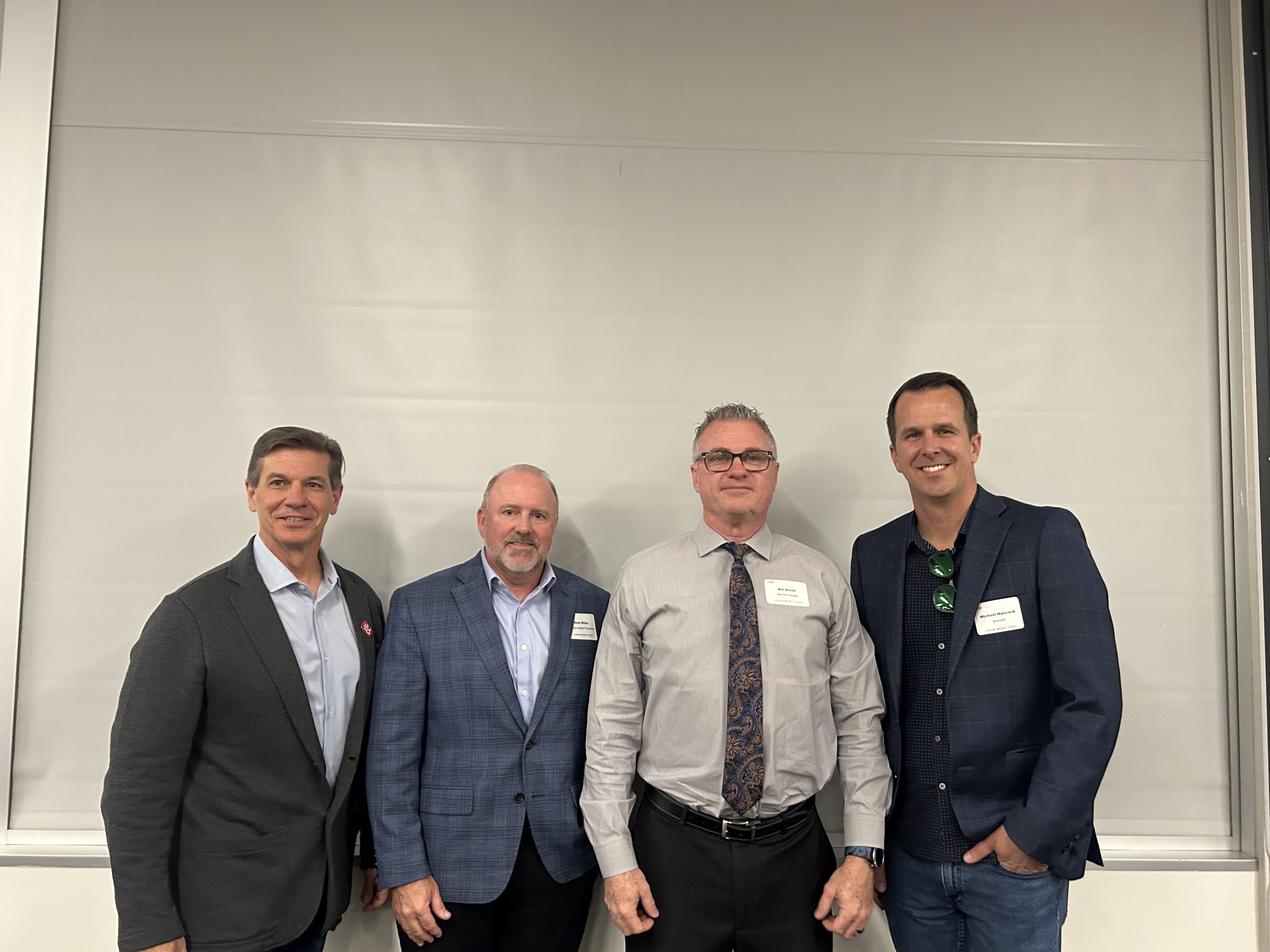
This year featured Michael Hancock, Executive Director of Preconstruction at Kitchell, as the moderator. The panel was comprised of:
- Russ Korcuska, SVP, Facilities and Supply Chain, Phoenix Children’s Hospital;
- Sean Miller, SVP of Development, Anchor Health Properties, and
- Bill Smith, Senior Project Executive, Banner Health.
Hancock started the session by asking panelists to give a brief overview of the projects and plans their companies were working on.
Smith went first and said Banner is currently preparing its project renewal capital plan for Q1. Plan volumes usually total approximately $85M, he said, but this year will be around $310M. Much of Banner’s current focus is on mechanical and electrical renewal, but there is roughly $300M in pending projects across the organization. Banner’s funding process is cash-dependent, having moved away from long-term capital improvement commitments in recent years.
Miller said Anchor Health Properties is currently working on its plans with Sun Health, wrapping a new facility for Brooks Rehabilitation and planning two new in-patient rehabilitation facilities, one in the East Valley and one in the West. Anchor is also working on multiple projects across the West and Southwest.
Korcuska focused largely on Phoenix Children’s work to expand its behavioral health offerings, including a 96-bed facility planned in the West Valley, for which the group is expecting to release a major announcement in the near future.
He added much of PCH’s main campus is in buildings that are nearly 50 years old, so the company is funding and planning for infrastructure improvements and equipment replacements.
Hancock next asked how the panelists’ organizations were changing in the current healthcare environment. Korcuska and Smith both said there is an enhanced focus on maximizing operational efficiencies.
Miller said Anchor’s partners are relying more on Anchor to lead facility development, rather than investing their own money to build new spaces. A key focus at the moment is in-patient rehabilitation facilities, which can be developed and built more effectively than acute care space.
“In the last two years,” Miller said, “we’ve probably seen double the growth of in-patient rehab facilities. We’re having to get more competitive on all our financial proposals as well. We have to look at cap rates and everything that goes along with it to make the project lendable or financially viable… Systems are looking to preserve capital, but they’re also looking to grow.”
Part of the move to enhance efficiency across operations has been reexamining and retooling processes on the operational side, including the deployment of artificial intelligence. Some of the processes have included AI review of contracts and standard documents to ensure consistency and uniformity, as well as asset review and maintenance planning and verification.
Smith said Banner uses AI to manage assets, but the company relies on humans to manage and oversee its processes.
Relationships and Partnerships Remain Key
All the panelists stressed the importance of growing expertise internally and establishing and maintaining relationships with leadership and the vendor network to ensure needs and operational requirements are understood at each stage of the project process and addressed collaboratively.
None of the panelists reported seeing significant projects being put on hold or canceled, but leadership changes and long development cycles can impact projects’ prioritization levels. New leadership often has a new vision that differs from the original planning that went into a project, which can lead to re-justifying projects or re-establishing their value to the organization and the community.
Korcuska said that while priorities may change, PCH usually pushes projects through to completion once they have begun.
Smith said one particular challenge is what he referred to as “corporate amnesia,” when projects take multiple fiscal years to plan, design and build. When a project has been in design and planning for a long time, its perceived urgency or importance can slip from the front of mind, requiring a multi-week process to get all the parties on board for the timeline when the construction is approaching.
Having to re-justify and re-explain the project value against multiple fiscal responsibilities and considerations is an essential part of the process, he explained, but it can cause pauses and frustration.
Technology, operational changes and rising costs and market forces have not changed the ongoing greatest need in healthcare project development, which remains the need for design and construction partners to effectively collaborate and communicate with organizations’ representatives at every stage of the process.
Given funding constraints, Korcuska said it is essential that partners shield the organizations from surprises that can impact costs or timelines.
He also stressed creativity and providing new perspectives, saying he wants to see development partners challenge his organization’s thinking and “break us out of our boxes.”
Miller and Smith agreed, saying it is essential for the design and construction community to manage lead times and procurements, as well as manage the talent to keep top performers engaged in the healthcare market.
Smith said healthcare is losing some of its most skilled design and construction partner team members to work in the rapidly growing areas of advanced manufacturing and data centers, and it is essential to preserve that team-based institutional experience with its sharp insights into healthcare’s specific needs if the healthcare industry is to fulfill its service and performance missions.