
By Brian P. D. Hannon for Associated Press
Sunbathers understand the benefits of applying sunscreen, but in America’s hottest big city the same concept is being tested at street level in the hope of bringing some lasting relief from the relentless Arizona sun.
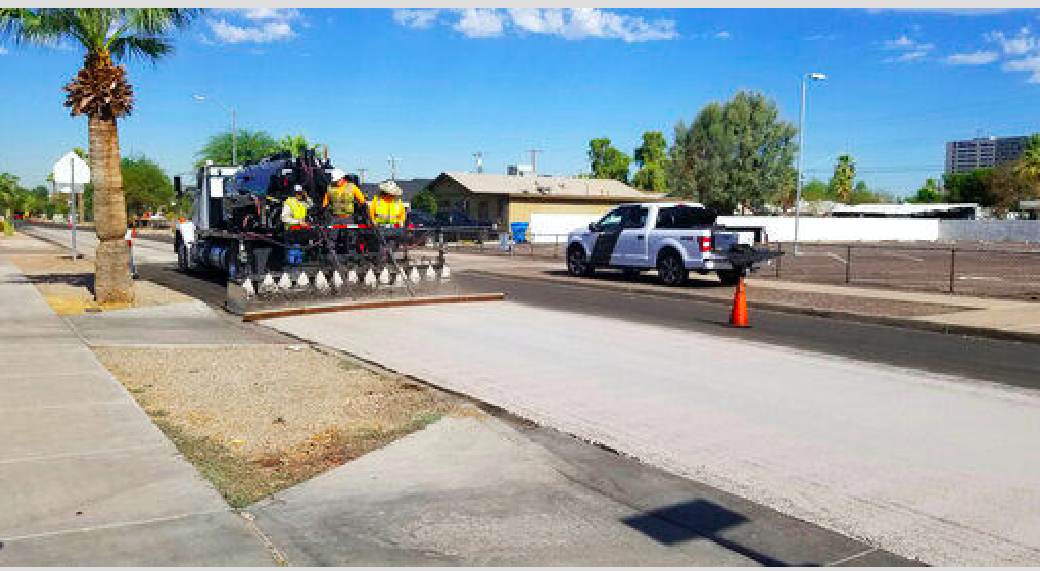
A team from Arizona State University is working with the City of Phoenix on a pilot program studying the use of “cool pavement” to reduce heat island effect, a phenomenon that raises temperatures in urban areas covered by asphalt and concrete.
Heather Murphy, a Street Transportation Department spokesperson, said Phoenix is applying cool pavement coating to nine sites representing different urban characteristics, from shaded streets to open lots. The applications are expected to be completed by the end of the month.
The Environmental Protection Agency says normal paving materials can reach temperatures of 120-150 degrees during peak summer and transfer excess heat into the air. Lowering the surface temperature can provide comfort and reduced energy costs to residents sheltering from extreme heat like the record levels reached this year.
Heat island effect is a “major factor” in both day and nighttime temperatures and a potential health hazard, Arizona State Climatologist Nancy Selover said, noting the particular risk to those who cannot afford air conditioning and homeless residents sleeping outside.
Ronnen Levinson, who leads the Heat Island Group at Lawrence Berkeley National Laboratory, said cool pavement can simultaneously address some of the most important issues facing the hottest cities in the U.S. and a world experiencing alarming climate change.
There are two basic categories of cool pavement, Levinson said. Reflective cool pavement has a lighter color and chemical properties that turn sunlight back toward the atmosphere rather than absorbing heat like dark asphalt. Evaporative pavement relies on rainwater seeping into its porous surface and then cooling the pavement and the air during slow evaporation. The choice of which technology to use is based on whether a city gets rain during its hottest months or is in a dry climate.
Reducing surface temperature can have direct benefits by lowering air temperature, which David Sailor, director of the Arizona State Urban Climate Research Center, said has “significant implications for heat-related illness, air quality, water use, and energy use.”
The Phoenix research team will take readings over time to determine how the cool pavement responds to city life, Sailor said.
Cool pavement coatings are typically made of polymers, the binding chemicals also used in house paint, and more energy and carbon is required to manufacture polymers than normal asphalt coatings, Levinson said.
Phoenix uses CoolSeal, which California-based GuardTop LLC said on its website is not a polymer, but rather a water-based, asphalt-emulsion the company claims can reduce surface temperatures by 10 to 30 degrees Fahrenheit.
Despite higher costs than ordinary asphalt, Sailor estimated cool pavement can result in notable savings in Maricopa County.
Murphy said the total cost of Phoenix’s pilot program is $3.3M.
The nine areas chosen were already due for resurfacing and the money would have gone toward rehabilitating those areas regardless of the material used, she said.
Read more at Arizona Daily Sun.

NEWS TICKER
- [October 14, 2026] - 3 Major Hotel Projects Advancing in Phoenix
- [October 13, 2026] - Prescott Council to Vote on Fairgrounds Master Plan
- [October 13, 2026] - Regional Medical Center to Build New Hospital in Safford
- [October 13, 2026] - Industry Professionals 10-13-26
- [October 13, 2026] - Commercial Real Estate 10-13-26
- [October 12, 2026] - San Tan Valley P&Z Recommends Approval for One Project, Denial for Another
- [October 10, 2026] - Construction Technology Report Focuses on Health and Safety Tech, Innovation
- [October 9, 2026] - After Slowdown and Shocks, Phoenix BTR Market is Poised for Comeback