

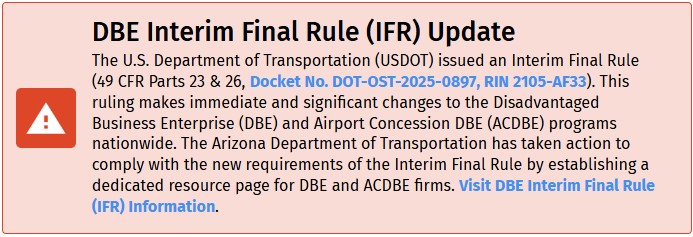
Since Oct. 3, 2025, the federal Disadvantaged Business Enterprise program has been in a state of enhanced chaos due to an Interim Final Rule, which effectively de-certified all existing DBE firms.
The DBE program is a component of most federally funded transportation projects, with goals assigned at the time of procurement for a certain percentage of the contract value required to go to a certified DBE firm. These are prevalent on contracts for both construction and professional services.
The current federal administration has taken a brash approach to removing and dismantling all forms of Diversity, Equity and Inclusion programs, and the DBE program is no exception. Up until this IFR in October 2025, obtaining a DBE certification was relatively straightforward, as race and gender were considered objective measures of disadvantage, along with personal net worth of the owner(s) not exceeding a defined threshold.
The IFR removes all race and gender from consideration and requires the business owner to prove social and economic disadvantage via a personal narrative without using either race or gender as criteria. The narrative must include specific examples of disadvantage, the impediment it created and the harm that resulted.
Arizona Nears Completion of Initial Reevaluation
In February, the three agencies that make up Arizona’s Unified Certification Program (Arizona Department of Transportation, City of Phoenix, and City of Tucson) started accepting applications for reevaluation. The initial deadline for submissions was March 31. While UCP agencies are still accepting applications for re-evaluation, time is running out. There is a June 30 deadline for certified DBEs to submit their reevaluation applications. After that cutoff, all firms that have not submitted their reevaluation will be delisted from the Arizona Unified Transportation Registration and Certification System, also known as UTRACS, and will have to start a new application to be considered.
New certifications for DBE certification will come after this reevaluation period concludes. UCP agencies had paused accepting new applications since the IFR was issued.
The result of the de-certifying has been expectedly stark. Before the IFR was issued, roughly 1,225 firms were certified DBEs in Arizona. According to Small Business Services Program Manager, Lorena Nava, only 277 firms have obtained a certified DBE status again through reevaluation. While reevaluations continue, this IFR and the resulting reevaluation are creating a sharp drop in certified DBE firms.
Long Term Surface Transportation Bill Includes DBE Program
The long-term outlook for the DBE program is tied to the federal Surface Transportation Reauthorization Bill. The current bill expires September 30 and has long been known to be the harbinger of whether the DBE program would continue to exist in any form. On May 17, the House Transportation & Infrastructure Committee chairs released the reauthorization bill that would begin on Oct. 1, 2026, titled the BUILD America 250 Act.
In the bill, the DBE program is reauthorized, albeit with changes. The term “minority- and women-owned business” will be replaced with “socially and economically disadvantaged individuals,” mirroring the IFR.
Additionally, the reauthorization bill will set a national, aspirational goal of at least 10% of federal funding to be directed to small businesses owned and operated by socially and economically disadvantaged persons. Lastly, the U.S. Department of Transportation will be responsible for creating objective criteria for state certifying agencies to evaluate whether the business owner qualifies as disadvantaged.
Project Goals Remain on Hold Until Reevaluations Are Complete and New Goals Can be Established
The shock to active projects and procurements that traditionally had DBE goals was immediate. When the IFR came out, local government appeared to be just as surprised as DBE firms by the immediacy of the action. In October 2025, eight ADOT and one City of Phoenix construction project bid opportunities had DBE goals that were subsequently removed via addenda. Existing project contracts were also thrown into a tizzy with confusion about how or whether to continue on with existing contract terms when contradictory directives are received.
ADOT is hosting an AZUCP webinar on June 23 at 9 am for firms interested in learning what comes after recertification. Program managers from the three partner agencies will be presenting. You can find out more about that webinar and register to attend here.