

The Arizona Office of Economic Opportunity has released its projections for employment in the Grand Canyon State for 2025-2035, and Construction promises to be near the top of the growth list.
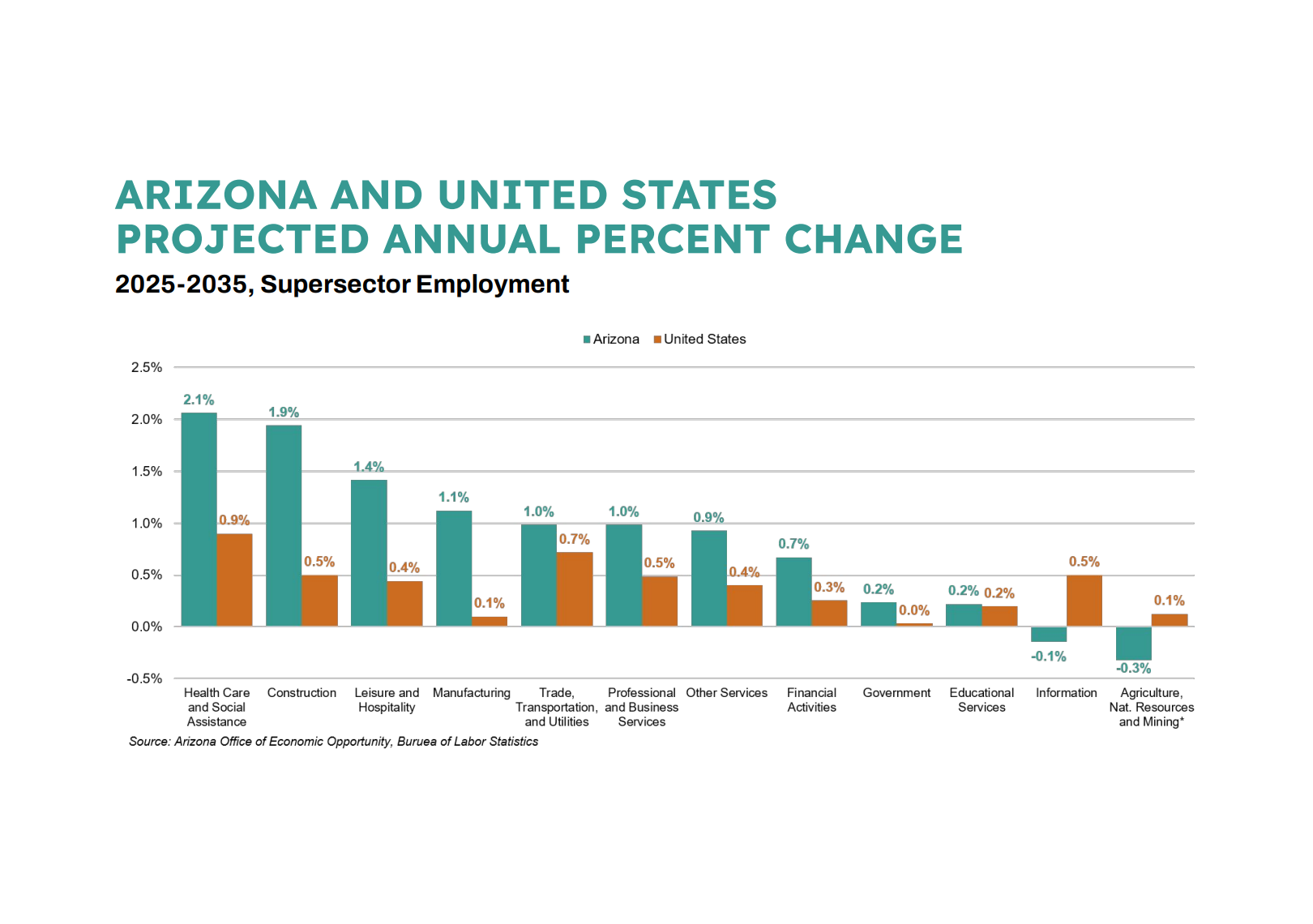
With a population that is both growing—albeit more slowly than in recent years—and aging, Health Care and Social Assistance leads growth sectors with an anticipated employment growth of 2.1% over the next 10 years. Construction, however, comes in a close second at 1.9%.
Natural Resources and Mining, which is closely associated with Construction and included with several smaller locales’ Construction employment numbers in monthly tallies, was one of only two subsectors projected to see an employment decrease, with jobs expected to fall 0.3%.
Across all supersectors, Arizona is projected to add 412,326 jobs through 2035, for a total of 3,889,995. “By comparison,” the announcement said, “United States employment is projected to grow by 0.3% annually from 2025 to 2035.”
The Arizona 2025-2035 Projected Employment Report anticipates 10-year growth across the 12 tracked supersectors as follows:
- Health Care and Social Assistance: 0.9%,
- Construction: 1.9%,
- Leisure and Hospitality: 1.4%,
- Manufacturing: 1.1%,
- Trade, Transportation and Utilities: 1.0%,
- Professional and Business Services: 1.0%,
- Other Services: 0.9%,
- Financial Activities: 0.7%,
- Government: 0.2%,
- Educational Services: 0.2%,
- Information: -0.1% and
- Agriculture, Natural Resources and Mining: -0.3%.
Arizona Vs. U.S.
Arizona outpaced projections for the nation overall across most sectors. The state and national estimates were the same for Educational Services, and the U.S. expects growth of 0.5% in Information and 0.1% in Agriculture, Natural Resources and Mining, the two sectors in which Arizona anticipates losses.
Nationwide growth predictions for Construction put Arizona well ahead of national projections. While Arizona is expected to see 1.9% growth, the nation as a whole can look forward to just 0.5%.
Assumptions and Considerations
The projections are predicated on several assumptions. Taken directly from the announcement, these include:
- No major, multi-year economic or political disruptions will occur during the projected period;
- Government agencies will operate within their budgets, maintaining baseline public sector employment;
- The broader U.S. economic framework will not differ significantly from the framework present in the base year;
- Long-term employment patterns will continue in most industries during the projected period;
- Arizona’s population growth is assumed to remain among the fastest in the nation, supported heavily by in-migration;
- Overall labor force participation rates will face downward pressure as the state’s population continues to age, limiting the speed at which employers can fill open positions, and
- Demand for healthcare services will increase as population demographics shift.
The presentation accompanying the report offered additional considerations that could impact Construction. The expansion of high-technology/advanced manufacturing in Arizona is expected to continue. “These investments will have long-term effects in construction, logistics, and business services,” it says.
The report then adds, “Construction employment will remain steady, while elevated interest rates will temper new private commercial development, heavy demand for public infrastructure investments and large-scale industrial megaprojects will sustain moderate growth.”
The report was issued Nov. 5, just two days after the most recent election, meaning it did not and could not factor in potential impacts of the significant gains made by Democrats in national government and across Arizona. Factors within the 10-year evaluation period that could influence employment conditions include potentially significant alterations in current tax and immigration policies, as well as tariffs and other international trade considerations.
A particularly Arizona-centric point to watch is data center development. Data centers have been a key driver of sustained activity in the Industrial sector both here and across the country. Associated Builders and Contractors recently cited data centers as the sole factor driving nonresidential construction spending and sustained backlogs in many parts of the country. Democrats have led efforts to restrict the pace and scale of data center development in Arizona and nationwide, and a widening of those efforts could impact construction volumes moving forward.
County-level Data
Perhaps surprisingly, Graham County is expected to see the highest overall job growth percentage, leading the state with 1.3%. Maricopa, Yavapai and Pinal counties all follow in a three-way tie for second place at 1.2%.
Looking at the other counties with significant population centers, Mohave County is expected to see an increase of 0.9%; Coconino County employment is expected to grow by 0.8%, as is Pima County. Yuma County follows closely behind with an expected employment increase of 0.7%.
The Current Snapshot
At every major BEX event, President and Founder Rebekah Morris presents an overview of macroeconomic and employment conditions in Arizona to establish a framework for Construction conditions in the state.
At October’s BEX Public Works Conference, Morris explained Construction employment was most recently reported at 227,600 positions. Despite ongoing growth since the Great Recession-era bottoming out at 110,800 jobs, the most recent totals are still 5.29% less than the 2006 peak of 240,300.
Over the next 10 years, Arizona Construction can finally expect to sail beyond that psychological barrier point. The total expected increase through 2035 is projected at 48,483 positions, which, if accurate, will be more than 35,000 more Construction jobs than the past peak.
We will leave the raw numbers on that high note and not bother to calculate Construction jobs as a percentage of population over those 30 years.