
Over the next five years, the City of Buckeye plans to invest nearly $30M to expand and improve Buckeye Airport in the start of a process that could eventually transform it into the West Valley’s equivalent of Mesa-Gateway Airport on the eastside.
Development of the Buckeye Airport Specific Plan for fiscal years 2026-2031 has been initiated and is currently undergoing community open houses and review.
A local news outlet reported roughly $16M of the $30M total is planned for a new air traffic control tower. City documents confirm an estimate of $16.17M. Another $5.5M will be used to extend the airport’s existing runway.
Approximately $23M of the funding will be provided through grants from the Federal Aviation Administration and Arizona Department of Transportation.
Currently designated as a general aviation airport, Buckeye Airport does not have a control tower and does not handle passenger flights at the moment. Citing the potential for service growth, Mayor Eric Orsborn recently said he would like to see it become a reliever airport for the Valley’s commercial airports, including Sky Harbor.
He said Buckeye Airport has the potential to grow to handle passenger, military and commercial traffic. Expansions will depend on both City Council approvals and market demand.
Surrounding development is a major factor in the airport’s planned growth. Nearly 70% of the land surrounding the airport is currently used for agriculture. Given currently planned development, by the time construction in that area is complete, 44% of the surrounding land will be in master-planned communities and neighborhoods; 14% will be taken up by employment uses, and 20% will be rural/agricultural.
Several one-lane roads in the surrounding area will be expanded into major streets with two or three lanes to handle volume, and the planned Interstate 11 freeway, if allowed to proceed, will be a significant influencing factor.
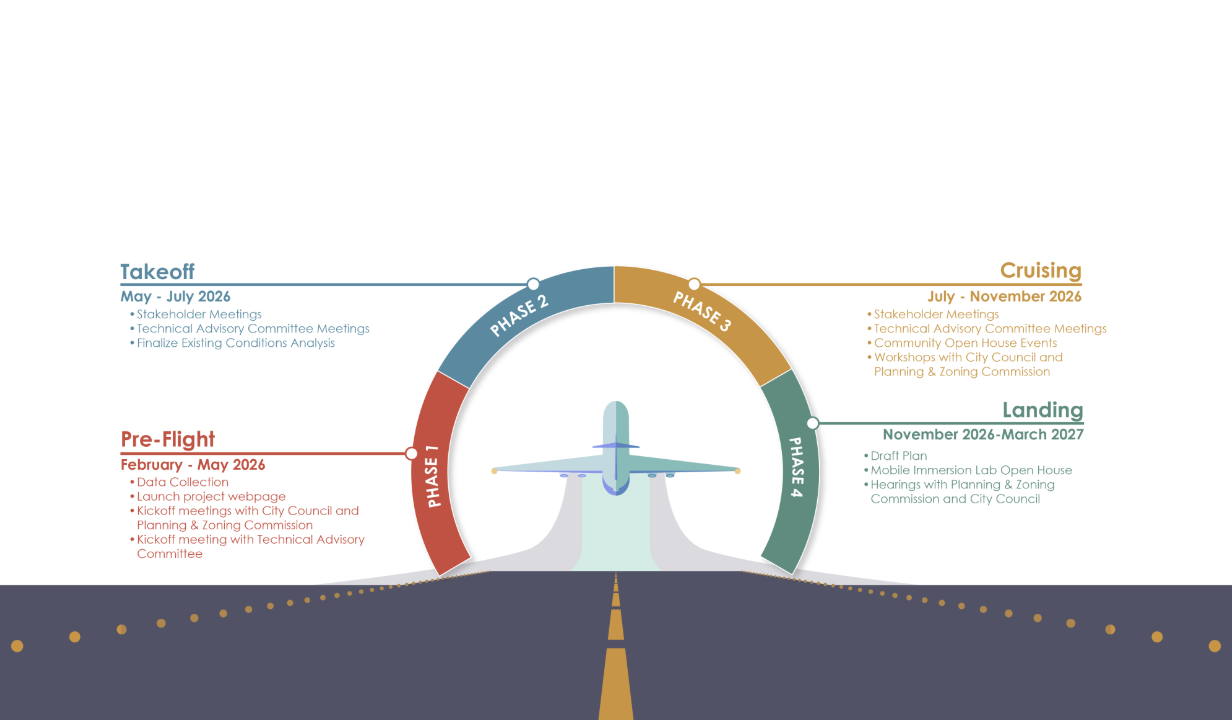
The four-phase Airport Specific Area Plan process started in February with data collection and kickoff meetings. It then advanced to stakeholder and Technical Advisory Committee meetings. Currently in the third phase, the stakeholder and TAC meetings continue, along with City Council workshops and community open houses. The fourth phase, currently planned from November through March, will deliver a draft plan, open houses with a “Mobile Immersion Lab,” and hearings before the Planning and Zoning Commission and City Council.
The most recent community meeting was held Sept. 23. Another is scheduled for Oct. 14.