

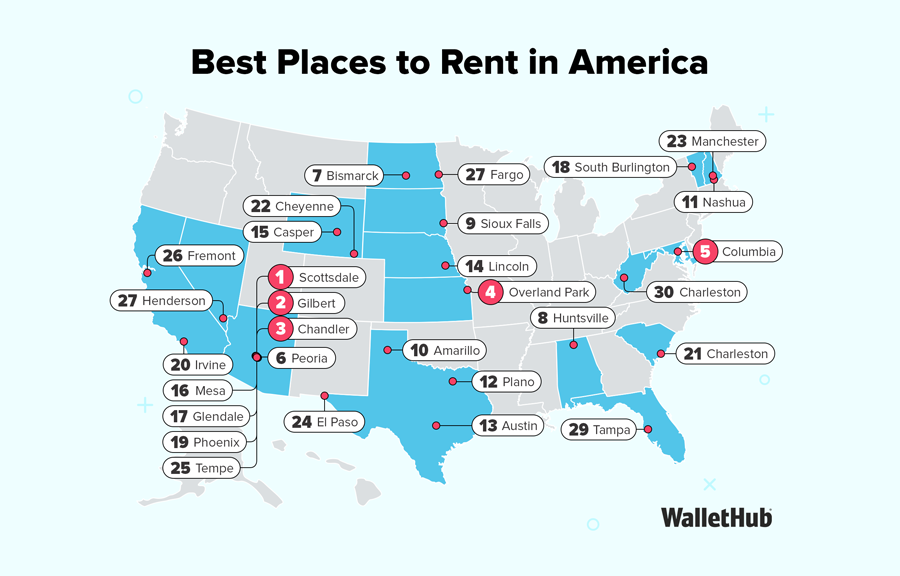
Four Arizona cities have been named in the Top 10 of WalletHub’s “Best Places to Rent in America” survey, with four more making the Top 25.
In what will almost certainly be viewed with horror and trepidation by Scottsdale’s anti-apartment contingent, that city secured the Number One position. The other Arizona cities and their rankings were:
- Gilbert, 2;
- Chandler, 3;
- Peoria, 6;
- Mesa, 16;
- Glendale, 17;
- Phoenix, 19, and
- Tempe, 25.
The survey covered 182 cities around the country and used 21 key metrics to measure the municipalities’ attractiveness and quality of life for renters.
Scottsdale’s overall quality of life was a primary factor in its high ranking, according to WalletHub Analyst Chip Lupo, who was quoted in the report.
“In the best cities for renters, rent can cost you as little as around 15% of your income. You’ll also have access to robust laws that protect renters, such as limiting deposits to only a month or two of rent. Our study also considers quality-of-life factors such as a city’s traffic congestion, job market or recreation options to make sure you can get a good living experience, not just inexpensive housing,” Lupo said.
The Criteria
WalletHub examined 182 cities in its study, making sure to include the 150 most populous cities and at least two cities in each state. Those cities were then evaluated for “Rental Market & Affordability” and “Quality of Life” across 21 individual metrics and given weighted averages.
Key Rental Market & Affordability considerations accounted for 60 points out of the total 100 and included:
- Share of renters,
- Rental vacancy rates,
- Share of newer homes,
- Rental affordability,
- Historical rental price changes and
- Share of cost-burdened rental households.
Major Quality of Life considerations included:
- The City Satisfaction Index, based on Sharecare’s Well-Being “Community” Index Score indicating residents’ views on their community,
- Job market,
- Recreation-Friendliness,
- Safety,
- Weather and
- Driver friendliness.
The Arizona Leaders
According to the report’s summary on Scottsdale, “Scottsdale isn’t the cheapest city to rent in, but it’s also far from the most expensive. It has the 57th-best rental affordability out of 182 cities, with most people only spending under 22% of their annual income on rent. The city also has one of the largest average home square footages in the country, at 2,179SF.”
Scottsdale also scored well for the availability of jobs, traffic and road infrastructure, and recreational opportunities.
Ironically, Scottsdale also has a reputation as one of Arizona’s most anti-apartment/anti-renter communities. Since 2020, opposition to multifamily development has been a front-and-center issue in campaigns for Mayor and City Council races, and the most recent primary election ensures two of the three seats under consideration will almost certainly be filled by staunchly anti-development candidates.
The only candidate to secure reelection outright in the recent voting, Solange Whitehead, had previously been considered part of the anti-development/NIMBY caucus. Given Council’s continued swing toward the opposition, and her votes to approve some developments under City of Scottsdale and Arizona state laws and guidelines, she is now considered centrist by most and pro-development by the stauncher factions of the opposition.
The City has consistently opposed efforts by the Arizona Legislature to facilitate more multifamily and alternative housing development and has been involved in multiple actions opposing both policy changes and specific developments.
Other Leading Markets
Gilbert was also praised for its larger-than-average home size of 2,101SF. The city of more than 290,000 residents, which refers to itself as a “town” for branding purposes, is the fourth most populous municipality in Arizona but still has the 37th best rental affordability, according to WalletHub’s research. The average person spends just 21% of their income on rent, and only 19% pay more than 50% of their income for housing. The town also has a reputation for quality schools, making it attractive for families.
Chandler also has a fairly large average square footage for homes, coming in at 1,888SF, and 17% of its housing inventory was built between 2010 and 2024. Most Chandler renters spend around 21% of their annual income on rent, and only 20% spend more than 50% of their income on housing.