
By Arizona Department of Transportation
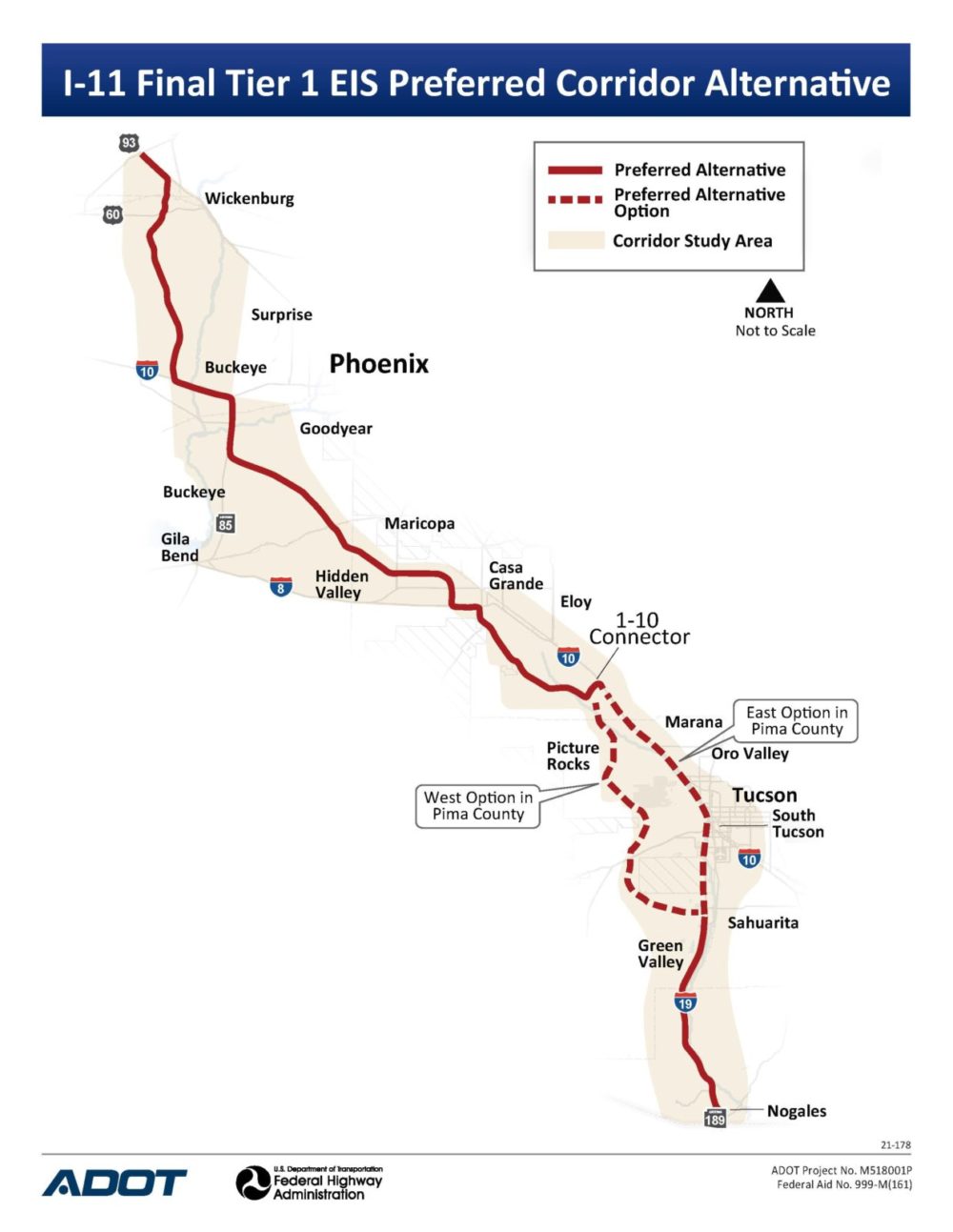
The Final Tier 1 Environmental Impact Statement for the 280-mile Interstate 11 study corridor – stretching from Nogales to Wickenburg – is now available for public review.
After five years of study, technical analysis and input from communities and stakeholders, this publication of the I-11 Final Tier 1 EIS marks a milestone for the proposed corridor.
The Final Tier 1 EIS, including a Preliminary Section 4(f) Evaluation, is available at i11study.com/Arizona. The website also lists locations throughout the study area where a hard copy of the Final Tier 1 EIS is available for review. The 30-day public review period runs through the close of business on Monday, August 16th. For information on how to submit a comment, visit the Contact Us page on the study website.
Prepared by the Arizona Department of Transportation and the Federal Highway Administration, the Final Tier 1 EIS was completed in compliance with the National Environmental Policy Act. It outlines the Preferred Corridor Alternative, including a parallel analysis of the No-Build Alternative.
The Final Tier 1 EIS focuses on the 2,000-foot-wide Preferred Corridor Alternative and the changes that were made since the publication of the 2,000-foot-wide Recommended Corridor Alternative in the Draft Tier 1 Environmental Impact Statement in April 2019.
The Final Tier 1 EIS document is presented in a condensed format that avoids repetition of material from the Draft Tier 1 EIS. The Final Tier 1 EIS is a much shorter document, references the Draft Tier 1 EIS, and includes a complete overview of the project and its impacts on the environment. ADOT and FHWA decided to use the condensed format, in part, to streamline complex information as requested by several cooperating and participating agencies.
In addition to the Final Tier 1 EIS document that will be posted online and available as a hard copy document at designated repository locations, an Interactive EIS will also be available on the I-11 study website. This is the first time ADOT has published an Interactive EIS. It contains the same information as the traditional Final Tier 1 EIS document in an interactive and engaging format.
ADOT and FHWA listened to and read every public comment submitted during the Tier 1 study. The study team gave consideration to comments from the public and stakeholders during the Draft Tier 1 EIS 90-day public comment period from April 5th, 2019 through July 8th, 2019. ADOT and FHWA made changes to the corridor after the Draft Tier 1 EIS public comment process was complete. Appendix H of the Final Tier 1 EIS documents the comments received on the Draft Tier 1 EIS and provides responses to those comments.
The process to develop a Preferred Corridor Alternative for the Final Tier 1 EIS included technical analysis; coordination with study partners such as cooperating agencies, participating agencies and tribal governments; and the review and consideration of public input received at study milestones.
Once the 30-day public review period is complete for the Final Tier 1 EIS, ADOT and FHWA will work toward a Record of Decision. That document, which is scheduled to be published in late 2021, will identify a Selected Corridor Alternative or the No-Build Option. The ROD marks the end of the Tier 1 EIS process.
If a build corridor is selected at the end of the Tier 1 study, further Tier 2 studies and evaluations must take place before construction could be considered. The corridor would be narrowed to a highway alignment, which is about 400 feet wide. An alignment determining where I-11 could be built would be decided during a future phase of design and environmental studies. Currently there are no plans or funding available to initiate these Tier 2 studies.
I-11 is envisioned as a multi-use corridor that would provide a connection from Mexico to the Hoover Dam, connecting with I-11 in Nevada. This proposed statewide highway would improve Arizona’s access to regional and international markets while opening up new opportunities for enhanced travel, mobility, trade, commerce, job growth and economic competitiveness. While the evaluation phase of this high-priority and high-capacity transportation corridor has begun, funding for further studies, design and construction has not been identified.
In 2015, the Fixing America’s Surface Transportation Act, or FAST Act, formally designated I-11 in Arizona. The designation doesn’t include funding but identifies I-11 as a high-priority corridor eligible for federal funding. I-11 is envisioned to include a combination of new and existing roadways. (Source)