
By Roland Murphy for AZBEX
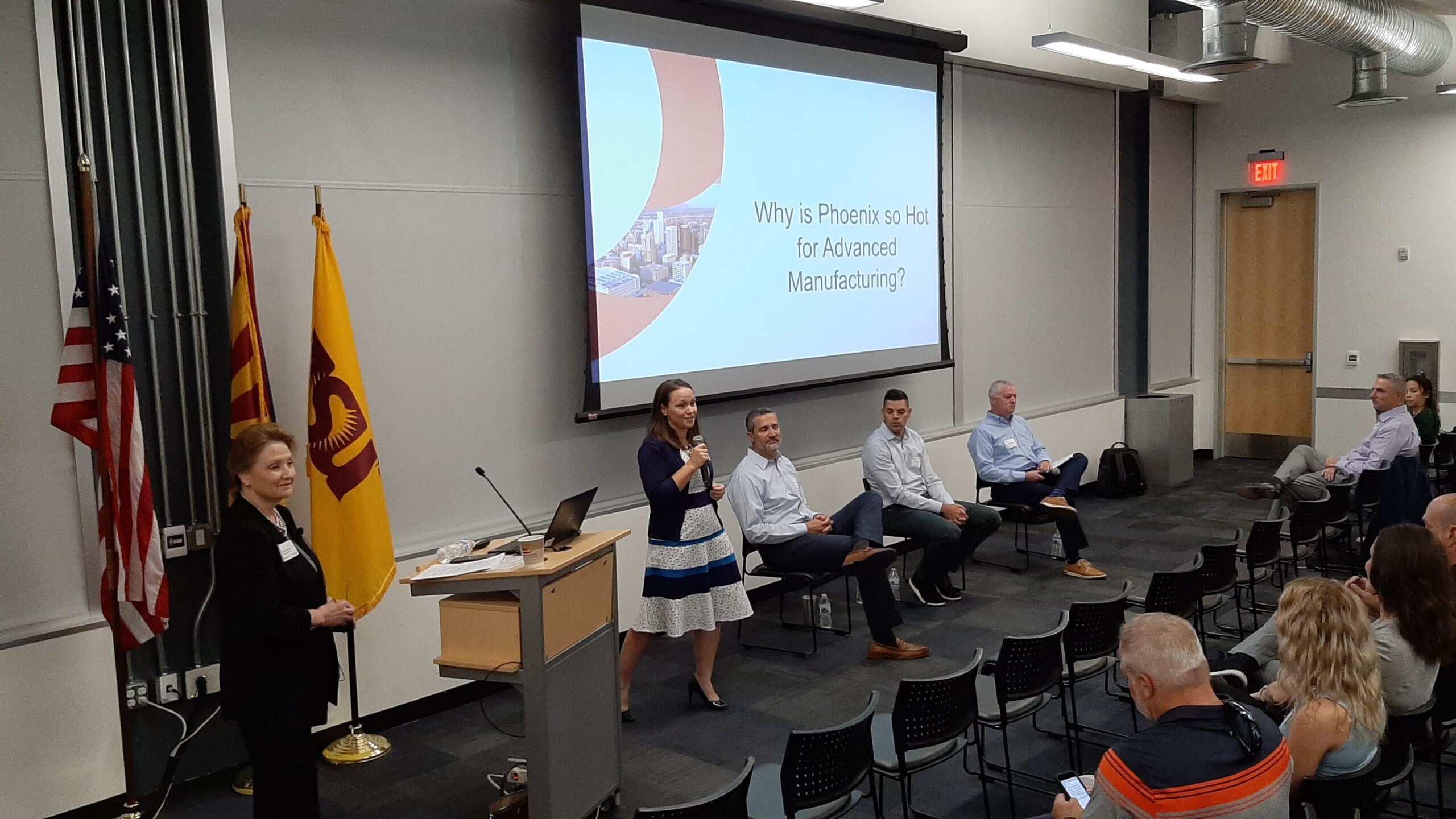
A near-capacity crowd packed into a conference room at ASU SkySong Building 3 for the BEX Events Leading Market Series panel on Advanced Manufacturing on August 3rd.
Moderated by City of Phoenix Community and Economic Director Christine Mackay, a panel comprised of Sundt Corporation Sr. VP Chad Buck, JLL Capital Markets Group Sr. Director Carl Beardsley and Farnsworth Group Principal Terry Rucker gave their views on the history, current state and projected future of advanced manufacturing as both an economic force and construction market presence in Arizona.
After setting the scene with a quick overview of Phoenix’s economic and demographic data, Mackay launched into a brief history of how Phoenix has become a leading center for advanced manufacturing in the U.S.
The area got its start in technology and manufacturing following World War II when the U.S. government began moving major defense industrial development facilities inland to minimize their risk of future attack. Among the leading manufacturers that emerged in Arizona as a result were Motorola, Honeywell and Allied Signal.
“But we lost our way,” she said, “In the 90s and early 2000s, we were all about growth. We were a market of growth for the sake of growth. We were making money on permits, on property tax, on sales tax, and the coffers were full. Cities and counties and the state never worried, and then came the Great Recession. As economic development leaders we’d been yelling at our leaders for decades saying we couldn’t be a market that was built on growth. We weren’t recession proof. We’d go into a recession and hockey stick right back out. And then we hit the bottom, and we hit the bottom hard… and the recession didn’t end for Arizona until 2014.”
Seizing on the notion of adversity as opportunity, economic development officials, state leaders, local officials and other stakeholders worked together, “and put together an incredibly robust package of tools to bring manufacturing back into Arizona,” Mackay said.
She then pivoted to praise the state’s university system, particularly Arizona State University, as a key contributor to attracting advanced manufacturer’s to locate in the state.
Mackay also expressed appreciation for Arizona’s having gone through the adversity and come out the other side. “We learned so much from the Great Recession… We are not going to let ourselves get trapped where we were in the 90s and the early 2000s, where we just lost our way. We’re already moving into new sectors.”
Identifying challenges and critical criteria when it comes to attracting advanced manufacturers, Mackay listed infrastructure – power, water, transit – and credited Phoenix and other area cities with putting together a robust infrastructure plan to drive development.
The State of Data Centers
Turning to the panel, Mackay first singled out Beardsley from JLL to ask what he is currently seeing in the market. After a brief overview explaining his team’s specialization in data centers, Beardsley gave a brief summary of activity and the dramatic growth in data center investment in the state in the past several years.
“We are really busy just finding sites,” he said. “We are sitting in the second hottest data center market in the country. The only one that surpasses Phoenix is the northern Virginia-Washington, D.C. area, which is the biggest hub in the world.”
Beardsley went on to tell the crowd 2021 was a record year for data centers in Phoenix, with lease-up absorption of 142MW, which was more than the last four years, total. In the first six months of 2022, the market has already exceeded 200MW. “It’s more than the last 10 years. It’s unprecedented demand.”
Beardsley credited most of the activity to hyperscale operations – major data companies in need of high-volume data center space – outsourcing their storage needs. One benefit Phoenix has over other markets is having data center infrastructure already in place, since it is easier for companies to expand their footprints than to build from scratch, he said.
The audience was particularly impressed when Beardsley showed slides comparing the 11 data center projects on the map in 2018 versus the 28 currently in place or in production around Phoenix.
In discussing the challenges currently facing the market, Beardsley sounded the universal problems with rising construction costs and expanded development times, particularly for power and dedicated substations. Where substation development once took 12 months, the current timelines reach as long as 36 months. He provided comfort, however, by noting the same process in California is now up to eight years.
Another key issue that has been problematic is the public perception of extreme water usage in data center operations. While that was once true, new efficiencies and closed cooling systems that recycle the same water over and over throughout the process have dramatically cut the daily and annual water volumes needed.
Sundt Overview
After Beardsley, Chad Buck with Sundt discussed his company’s involvement in semiconductors, data centers and other aspects of advanced manufacturing.
He praised the way the Arizona economy has diversified in recent years. “Our project portfolio has changed significantly on the commercial side,” he said, “where we’re much more engaged with tech-type projects and advanced manufacturing.”
He also expressed amazement at the ripple effects caused by the expansion of semiconductor manufacturing in the state, particularly from the Taiwan Semiconductor Manufacturing Company development and the massive influx of supporting suppliers that are looking for space and facilities as a result.
“The opportunity here is immense,” Buck said, “and honestly we don’t see it slowing.” A short time later he said, “I think we’re going to hit an interesting tipping point. Because of the number of companies that are coming into town, we’re coming into a strange time where there is almost more opportunity than contractors. It’s a very strange balance… The question is whether contractors will be smart enough to only take on what they can handle.”
Buck also decried the same market challenges as nearly every other industry expert in the last two years: Supply chain constraints, labor availability and, more recently, inflation. He was particularly frustrated by the scale and unpredictability of materials availability from structural steel all the way down to paint.
Mackay took the opportunity to compliment Sundt on its widely regarded apprenticeship and vocational training efforts, which have won national recognition.
Farnsworth and Process Development
Next to speak was Terry Rucker, who spoke at length about Farnsworth Group’s work in Phoenix and the semiconductor industry.
In particular, as a leading process engineering firm, Farnsworth worked closely with TSMC to help organize how to take a project that has been replicated many times in Taiwan and build it in the United States, given the significant differences between construction cultures, building codes and other concerns.
“The way they construct and design is wholly different over there,” Rucker said. “There was a big learning curve.”
A key component of Farnsworth’s efforts was to work the process so plans could be developed, revised, approved, permitted and implemented in the U.S. Rucker said his company has focused primarily on the auxiliary buildings, rather than the fabrication facilities, themselves, which has required close collaboration with the fab construction team and TSMC. He estimated the work totaled 40 architects working in six different offices. He added the degree of security and the scale of operation made efficient collaboration an absolute necessity.
Also focusing on TSMC, Buck echoed the collaborative aspect and the learning curve. He described the process of building the auxiliary buildings while Austin Commercial Group does the same for the fab buildings. The initial focus was on first handling the civil/structural/architectural scope (the shell) put together. Now that the two fabs under construction are making progress, the process is moving to the mechanical/electrical/plumbing outfitting to get ready for the tools and equipment that will be arriving from all over the world.
“We’ve had challenges, as has everyone that’s out there right now. There’s been a little bit of a learning curve… I’ve seen a significant improvement in the last 12 months at how much smoother things are operating now. TSMC has done a great job of figuring out the lay of the land and how to get work done here in the states.”
He continued, “I think now that the first ones’ are getting into the MEP systems, we’re going to see a significant improvement in the workflow as they work their way around the ‘U’ for those of you familiar with the site. Hopefully they just move right into the next round of fabs after these first two are completed.”
While TSMC has not made an official declaration, unofficial comments from senior executives, as well as global news sources, have confirmed that the potential exists for as many as six fabrication centers on the TSMC Phoenix site, depending on market conditions over time. The company already has so-called GIGAFAB™ sites with eight fab units in Taiwan.
The Future
While Arizona has benefitted greatly from expansions in advanced manufacturing and targeted economic development, Mackay closed the event with a look to the future.
In particular, she praised the potential for growth offered by the CHIPS Act, which will incentivize semiconductor and chip-related manufacture in the U.S. to reduce the country’s dependence on foreign suppliers.
It has been commonly reported that the U.S.’ share of chip manufacturing has fallen to an all-time low of just 12% of the market, which supporters of the legislation point out is both an economic and national security deficiency.
She praised the Arizona-focused efforts of everyone involved from Senator Mark Kelly down to local officials and economic support groups in working to get the legislation enacted. “It will change the diversification of companies that we can bring into the United States now because we are now competitive.”
She concluded by saying, “I would argue that the CHIPS Act will make the single most important difference to bringing advanced manufacturing and chip manufacturing back to the United States. Nothing more important – in my 30-year career – has been accommodated for in terms of being able to bring that forward.”