What's Hot

    North Valley Academy to Build New Development Center

    January 21, 2026

    Zoning Change Could Bring Data Centers to Belmont Mixed-Use Area

    January 20, 2026

    Chandler RFQ Seeks Tumbleweed Park Developer

    January 20, 2026
    Facebook Twitter Instagram
    AZBEX
    NEWS TICKER
    • [January 21, 2026] - North Valley Academy to Build New Development Center
    • [January 20, 2026] - Zoning Change Could Bring Data Centers to Belmont Mixed-Use Area
    • [January 20, 2026] - Chandler RFQ Seeks Tumbleweed Park Developer
    • [January 20, 2026] - Activists Sue Over Project Blue
    • [January 20, 2026] - Industry Professionals 01-20-26
    • [January 20, 2026] - Commercial Real Estate 01-20-26
    • [January 16, 2026] - 2 Data Center Projects Advancing in Metro Phoenix
    • [January 16, 2026] - Flagstaff Seeking Grant for JW Powell Extension
    LinkedIn Facebook
    • Home
    • News
      1. View Latest
      2. ✎ Planning & Development
      3. 📰 Local News
      4. 🔎︎ Classifieds
      5. 🕵 Editorial Analysis
      6. 💰 Budgets & Funding
      7. 🏢 Commercial Real Estate
      8. 👔 People on the Move
      9. 🌵 Arizona Projects
      10. 🏛️ Legislation & Regulations
      11. 📈 Trends

      North Valley Academy to Build New Development Center

      January 21, 2026

      Zoning Change Could Bring Data Centers to Belmont Mixed-Use Area

      January 20, 2026

      Chandler RFQ Seeks Tumbleweed Park Developer

      January 20, 2026

      2 Data Center Projects Advancing in Metro Phoenix

      January 16, 2026

      Activists Sue Over Project Blue

      January 20, 2026

      Trade Deal Could Spur New TSMC Expansion

      January 16, 2026

      ASU 2025 Project Update Highlights a Range of Service Areas

      January 9, 2026

      ADOT Announces Major Projects for 2026

      December 30, 2025

      Developers Must Work Differently to Counter Intensifying Project Opposition

      January 6, 2026

      Scottsdale Hospitals War May Heat Up with New Banner Request

      July 29, 2025

      Glendale Voters to Determine VAI Resort’s Fate

      May 16, 2025

      Legislation Would Effectively Strip NIMBYs of Referendum Tool

      February 11, 2025

      Gilbert Considering Other Methods to Fund Transportation Projects

      January 6, 2026

      Public School Bonds Split at the Ballot

      November 7, 2025

      Early voting for Coconino Community College bond begins this week

      October 7, 2025

      Yuma Funding CIP Projects with $116M Bond Issuance

      September 24, 2025

      Commercial Real Estate 01-20-26

      January 20, 2026

      Commercial Real Estate 01-13-26

      January 13, 2026

      Commercial Real Estate 01-06-26

      January 6, 2026

      Commercial Real Estate 12-23-25

      December 23, 2025

      Industry Professionals 01-20-26

      January 20, 2026

      Industry Professionals 01-13-26

      January 13, 2026

      Industry Professionals 01-06-26

      January 6, 2026

      Industry Professionals 12-23-25

      December 23, 2025

      Arizona Projects 01-16-26

      January 16, 2026

      Arizona Projects 01-09-26

      January 9, 2026

      Arizona Projects 12-30-25

      December 30, 2025

      Arizona Projects 12-19-25

      December 19, 2025

      Activists Sue Over Project Blue

      January 20, 2026

      Major Changes Coming for Arizona Planning and Development

      December 5, 2025

      Public School Bonds Split at the Ballot

      November 7, 2025

      Ritz-Carlton Developer Declares Chapter 11 in Bid to Retain Project

      November 7, 2025

      Phoenix Construction Costs See 4.76% Q4 Annual Change

      January 16, 2026

      U.S. Construction Down 11,000 Jobs in Dec, Up 14,000 for 2025

      January 14, 2026

      Phoenix Industrial Pipeline Contracted, Vacancy Rose Slightly in Q4

      January 13, 2026

      Ariz. Construction Lost 1,100 Jobs in November

      January 9, 2026

      North Valley Academy to Build New Development Center

      January 21, 2026

      Zoning Change Could Bring Data Centers to Belmont Mixed-Use Area

      January 20, 2026

      Chandler RFQ Seeks Tumbleweed Park Developer

      January 20, 2026

      Activists Sue Over Project Blue

      January 20, 2026
    • AZBEX
      • Subscribe
      • Solicitations
      • Classifieds
      • Advertising
    • DATABEX
      • DATABEX Log-In
      • Webinars
      • Monthly Snapshot
    • Events
      • 2026 Construction Activity Forecast
    • About Us
      • Meet the Company
      • Meet the Sales Team
      • Meet the Editorial Team
      • Meet the BEXperts
    • CIP Special Report
    AZBEX
    Home»Budgets & Funding»Special Coverage: Maricopa County Transportation Economic Impact
    Budgets & Funding

    Special Coverage: Maricopa County Transportation Economic Impact

    BEX StaffBy BEX StaffOctober 14, 2022No Comments6 Mins Read
    Credit: Maricopa Association of Governments
    Share
    Facebook Twitter LinkedIn Pinterest Email

    By Roland Murphy for AZBEX

    The ease of transportation for both people and cargo is a primary driver for economic development and sustained quality of life for any area.

    While Arizonans in general and Greater Phoenicians in particular often complain about commute times, data from Best Places show the metro area’s average commute of 25.4 minutes is right on par with the national average of 26.4 minutes. The quality and flexibility of Maricopa County’s transportation infrastructure is the primary contributor to keeping that commute time manageable, particularly given the fact that the state’s population has swelled from 1.78 million in 1970 to 7.17 million in 2020, according to the U.S. Census Bureau.

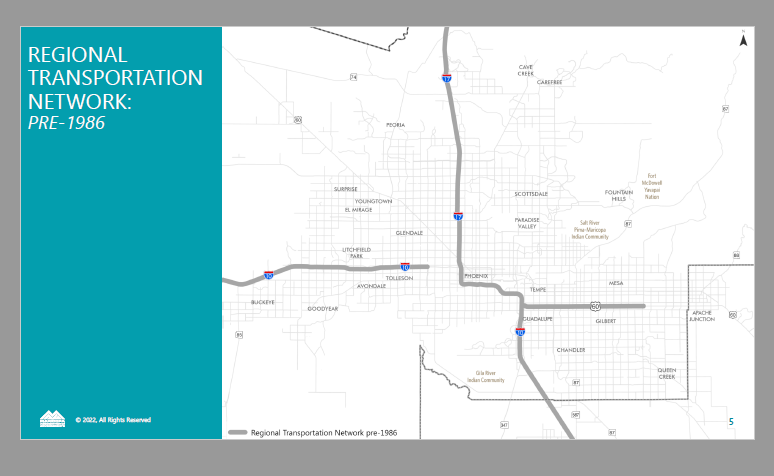
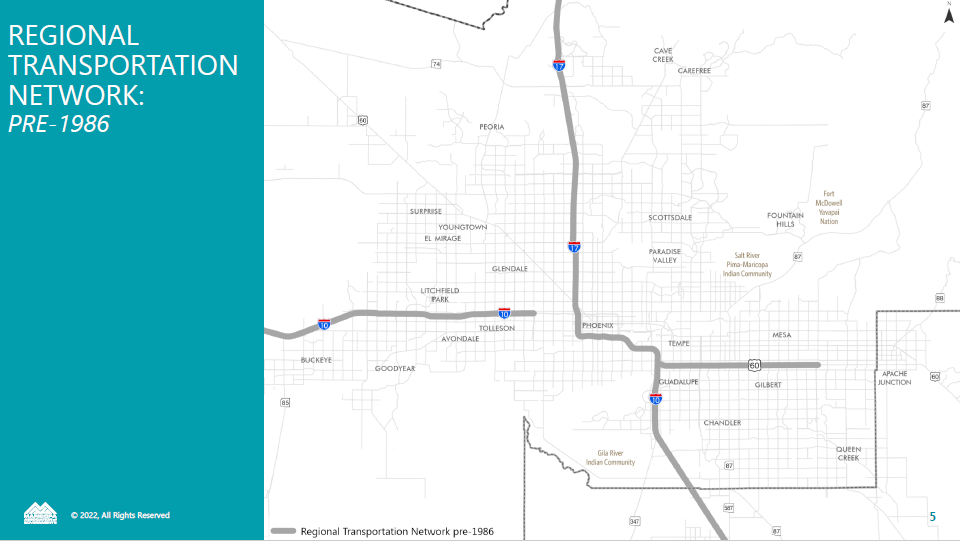
    Nearly every facet of that transportation infrastructure put in place since 1985 has been the result of Maricopa County’s half-cent transportation sales tax to one degree or another, and it is difficult-to-impossible to imagine life in the Valley without the expansive network of freeways, major arterials, light rail and other transit options put into operation since the tax was first approved by voters in 1985.

    According to information from the Maricopa Association of Governments, Maricopa County’s freeways in the existing transportation system reduce average travel times by 25% and save 105 hours in traffic per driver per year.

    Because of the expansiveness of the existing transportation network, 80% of jobs in Maricopa County are within two miles of a freeway or light rail corridor. Homes within a quarter mile of the freeway network have appreciated in value 212% between 2000 and 2019, and those within a quarter mile of a light rail line have appreciated 316%.

    While the direct economic impacts of the freeway system and projects put in place since 1986 are nearly impossible to calculate, light rail – which is another key component of the overall transportation plan and programming – is much easier. According to information from Valley Metro, as of 2017:

    • 35,000 new jobs had been created within one-half mile of light rail lines,
    • 50MSF of new construction across 344 projects was undertaken,
    • 25,000 new residential units and 4,000 new hotel rooms were added, and
    • Public and private investment in the corridor had reached $11B.

    Another Anti-Arizona Economic Development Talking Point

    In our recent look at Arizona’s water infrastructure and supplies, we shared a discussion with Jason Morris of land use law firm Withey Morris PLC. He discussed the economic development impacts of shallow reporting on Phoenix and Arizona’s ability to compete with other cities and states when it comes to attracting new opportunities. He said the doom and gloom reporting on Arizona’s water supply and infrastructure gave competing cities a negative talking point and put Arizona-based economic development representatives on the defensive. (AZBEX, Oct. 7)

    The exact same circumstance applies when the infrastructure component shifts from water to roads. In Austin, there is an expansion project to widen and improve capacity and usability for Interstate 35. The I-35 Capital Express project recently wrapped up a feasibility study for a major component of the project’s central section and is moving into the Design phase.

    Taking Morris’ example above and applying it here, an Austin economic development official who’s competing with Arizona for a major employment location or expansion opportunity (Does anyone remember the fight last year between Queen Creek, Goodyear, upstate New York and Austin for a $17B Samsung semiconductor plant?) could easily – and accurately – say, “We’re in the midst of investing nearly $5B in our freeway system to improve accessibility and commute times, among other things. Arizona just scrapped investment in its 25-year transportation improvement plan. How good is that going to be for your workforce? What does that mean for your continuity of manufacturing? Are you sure you want to do this?”

    Conversely, The Maricopa Association of Governments estimates the competitive edge for Arizona businesses if the transportation tax is extended will increase local sales by $113B. MAG also estimates $73B in travel time savings and improved reliability across the region. Businesses will save $40B in travel time and $4.4B in shipping and logistics costs.

    In-migration, Company Locates and ‘The California Effect’

    One of the primary factors in Arizona’s economic development success in recent years has been the state’s rate of in-migration. Maricopa County consistently ranks as one of, and often the, fastest growing counties in the U.S, with new residents hitting 58,000 between July 2020 and July 2021.

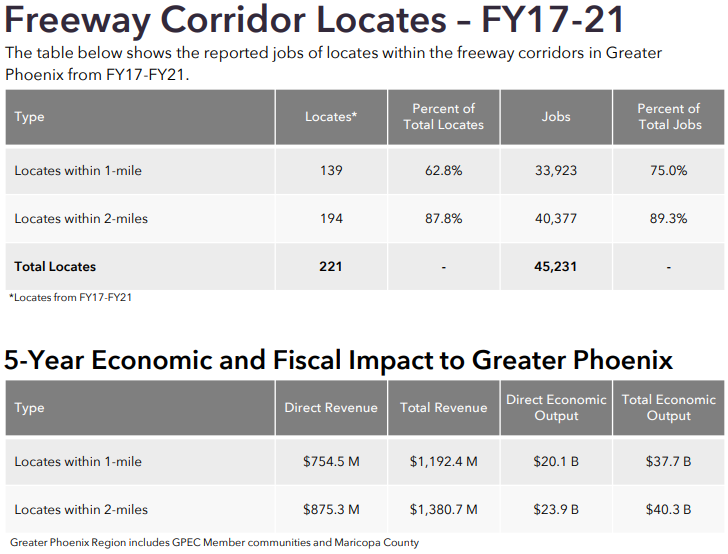
    The tables above feature data from the Greater Phoenix Economic Council and show just how much freeway and transportation proximity impacts companies’ decisions to locate here.
    There is another statistic to keep in mind: 23.9% of new Arizona residents come from California. It’s worth noting that long, congested commutes are a stereotype of California living and that transportation infrastructure is one of the many reasons companies and people cite for leaving the state and relocating here. If our congestion and commute times increase because our transportation network no longer keeps up with our population volume, that could be another harmful impact to economic development efforts and competitiveness.

    Economic Benefits of Prop 400E

    As part of its research and campaign efforts in support of the Proposition 400 Extension – also called Prop 400E – the Maricopa Association of Governments has produced a detailed economic impact analysis.

    Among the major benefits associated with Prop 400E are:

    • Of particular importance to Architecture/Engineering/Construction, the planned transportation investments will establish or improve access to 87,000 acres of developable land, much of which is State Trust Land,
    • $1.6B/year in net new income (more than $40B total),
    • Nearly $60B in net new economic activity due to transportation improvements,
    • 31,600 net new jobs, and
    • 87% of planned transportation investments will improve access to regional job centers.
    Arizona and Metro Phoenix have numerous advantages over other areas, but all the good weather, educated workers, low natural disaster risk and electrical grid infrastructure we can offer are significantly diminished if people cannot get to their jobs and materials cannot get to producers in a reasonable and cost-effective amount of time.

    While it is easy to get wrapped up in these more esoteric long-term benefits, there is also a staggering right here/right now direct economic point to consider as well. For freeway-related project alone, MAG’s Regional Strategic Infrastructure Investment Plan as of June 2022 is made up of 89 capital projects across 14 corridors.

    Total estimated capital costs for those 89 projects are more than $14.2B, much of which is now at risk if a path to the ballot is not found for Prop 400E.

    Arizona State Legislature Audra Koester Thomas commute times Doug Ducey economic competitiveness economic development HB 2685 highways/roads & streets In-migration Jason Morris John Bullen MAG Maricopa Association of Governments Prop 400 Prop 400E Proposition 400 Public Regional Strategic Infrastructure Investment Plan Sales tax special election transportation tax U.S. Census Bureau Withey Morris PLC
    Share. Facebook Twitter Pinterest LinkedIn WhatsApp Reddit Tumblr Email

    Related Posts

    Chandler RFQ Seeks Tumbleweed Park Developer

    January 20, 2026

    Flagstaff Seeking Grant for JW Powell Extension

    January 16, 2026

    Board Chosen to Oversee Chase Field Renovations

    January 9, 2026

    Leave A Reply Cancel Reply

    Our Picks

    North Valley Academy to Build New Development Center

    January 21, 2026

    Zoning Change Could Bring Data Centers to Belmont Mixed-Use Area

    January 20, 2026

    Chandler RFQ Seeks Tumbleweed Park Developer

    January 20, 2026

    Activists Sue Over Project Blue

    January 20, 2026
    Stay In Touch
    • Facebook
    • Twitter
    • LinkedIn
    • YouTube
    Don't Miss
    Planning & Development

    North Valley Academy to Build New Development Center

    January 21, 20260

    The City of Phoenix has approved a preliminary site plan that will enable North Valley…

    Zoning Change Could Bring Data Centers to Belmont Mixed-Use Area

    January 20, 2026

    Chandler RFQ Seeks Tumbleweed Park Developer

    January 20, 2026

    Activists Sue Over Project Blue

    January 20, 2026

    BEX serves architecture, engineering and construction firms as well as all the ancillary product and service categories that market to them. These include manufacturing representatives, public agencies and private real estate organizations, specialty subcontractors and services providers related to our industry.

    Our Picks

    North Valley Academy to Build New Development Center

    January 21, 2026

    Zoning Change Could Bring Data Centers to Belmont Mixed-Use Area

    January 20, 2026

    Chandler RFQ Seeks Tumbleweed Park Developer

    January 20, 2026
    Contact Us

    Phone: 480-709-4190
    Address: P.O. Box 12196 Tempe, AZ 85284
    Email: sales@azbex.com

    Type above and press Enter to search. Press Esc to cancel.