What's Hot

    Hearing Postponed for 146-Unit Multifamily in Apache Junction

    May 1, 2026

    New Scottsdale Airport Parking Project Raises Questions

    May 1, 2026

    Proposed State Budget to Cut Economic Development Programs in Favor of Tax Cuts

    May 1, 2026
    Facebook Twitter Instagram
    AZBEX
    NEWS TICKER
    • [May 1, 2026] - Hearing Postponed for 146-Unit Multifamily in Apache Junction
    • [May 1, 2026] - New Scottsdale Airport Parking Project Raises Questions
    • [May 1, 2026] - Proposed State Budget to Cut Economic Development Programs in Favor of Tax Cuts
    • [May 1, 2026] - Arizona Projects 05-01-26
    • [April 29, 2026] - 400KSF of New Hangar Space Planned at Phoenix Goodyear Airport
    • [April 28, 2026] - AI Yields Benefits and Risks in Planning and Zoning
    • [April 28, 2026] - Affordability Reform Legislation May Gut BTR Sector
    • [April 28, 2026] - Major Changes Submitted for S. Phoenix Mixed-Use
    LinkedIn Facebook
    • Home
    • News
      1. View Latest
      2. ✎ Planning & Development
      3. 📰 Local News
      4. 🔎︎ Classifieds
      5. 🕵 Editorial Analysis
      6. 💰 Budgets & Funding
      7. 🏢 Commercial Real Estate
      8. 👔 People on the Move
      9. 🌵 Arizona Projects
      10. 🏛️ Legislation & Regulations
      11. 📈 Trends

      400KSF of New Hangar Space Planned at Phoenix Goodyear Airport

      April 29, 2026

      Major Changes Submitted for S. Phoenix Mixed-Use

      April 28, 2026

      97KSF Industrial Park Proposed in Maricopa

      April 24, 2026

      62-Unit Townhome Development Planned in San Luis

      April 24, 2026

      New Scottsdale Airport Parking Project Raises Questions

      May 1, 2026

      AI Yields Benefits and Risks in Planning and Zoning

      April 28, 2026

      Coolidge to Start Planning for Water Treatment Plant Expansion

      April 24, 2026

      Mesa Considering Small-Scale Transportation Project Program

      April 20, 2026

      Affordability Reform Legislation May Gut BTR Sector

      April 28, 2026

      Developers Must Work Differently to Counter Intensifying Project Opposition

      January 6, 2026

      Scottsdale Hospitals War May Heat Up with New Banner Request

      July 29, 2025

      Glendale Voters to Determine VAI Resort’s Fate

      May 16, 2025

      Proposed State Budget to Cut Economic Development Programs in Favor of Tax Cuts

      May 1, 2026

      Mesa City Council Approves $61M GO Bond Sale

      April 10, 2026

      Gilbert Schools Considering $136M Bond Request

      March 31, 2026

      Ruling Give 8 Months, No Guidance, For State to Fix School Funding

      March 10, 2026

      Commercial Real Estate 04-28-26

      April 28, 2026

      Commercial Real Estate 04-21-26

      April 22, 2026

      Commercial Real Estate 04-14-26

      April 14, 2026

      Commercial Real Estate 04-07-26

      April 7, 2026

      Industry Professionals 04-28-26

      April 28, 2026

      Industry Professionals 04-21-26

      April 22, 2026

      Industry Professionals 04-14-26

      April 14, 2026

      Industry Professionals 04-07-26

      April 7, 2026

      Arizona Projects 05-01-26

      May 1, 2026

      Arizona Projects 04-24-26

      April 24, 2026

      Arizona Projects 04-17-26

      April 17, 2026

      Arizona Projects 04-10-26

      April 10, 2026

      Affordability Reform Legislation May Gut BTR Sector

      April 28, 2026

      Judge Finds ADWR Groundwater Policy Actions Illegal

      April 24, 2026

      Flagstaff Considering Imposing Data Center Restrictions

      March 27, 2026

      Cities May Have to Pay for Data Center Zoning Restrictions Under State Law

      March 27, 2026

      Ariz. Construction Added 2,900 Jobs in February

      April 22, 2026

      Home Builder Sentiment Dips in April

      April 22, 2026

      Data Centers Fuel Backlog Increase; Confidence Remains High

      April 17, 2026

      Industrial and Office Data Show Healthy Markets in Q1

      April 14, 2026

      Hearing Postponed for 146-Unit Multifamily in Apache Junction

      May 1, 2026

      New Scottsdale Airport Parking Project Raises Questions

      May 1, 2026

      Proposed State Budget to Cut Economic Development Programs in Favor of Tax Cuts

      May 1, 2026

      Arizona Projects 05-01-26

      May 1, 2026
    • AZBEX
      • Subscribe
      • Solicitations
      • Classifieds
      • Advertising
    • DATABEX
      • DATABEX Log-In
      • Webinars
      • Monthly Snapshot
    • Events
      • 2026 Mid-Year Update
    • About Us
      • Meet the Company
      • Meet the Sales Team
      • Meet the Editorial Team
      • Meet the BEXperts
    • CIP Special Report
    AZBEX
    Home»Trends»Construction Costs Latest Indicator of Complicated Phoenix Economy
    Trends

    Construction Costs Latest Indicator of Complicated Phoenix Economy

    Roland MurphyBy Roland MurphyMay 6, 2022No Comments6 Mins Read
    Credit: Rider Levett Bucknall
    Share
    Facebook Twitter LinkedIn Pinterest Email

    NEWSFLASH: Construction costs keep going up.

    BREAKING NEWS: They’re going up more quickly and at higher rates in already hot markets like Phoenix.

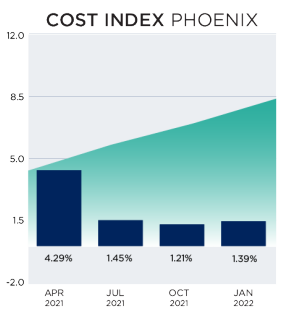
    Add one more data point into the complex morass of economic data swirling around the good news/bad news currently making up Arizona construction and economic reporting. Rider Levett Bucknall has just issued its “North America Quarterly Construction Cost Report” for Q1 2022.

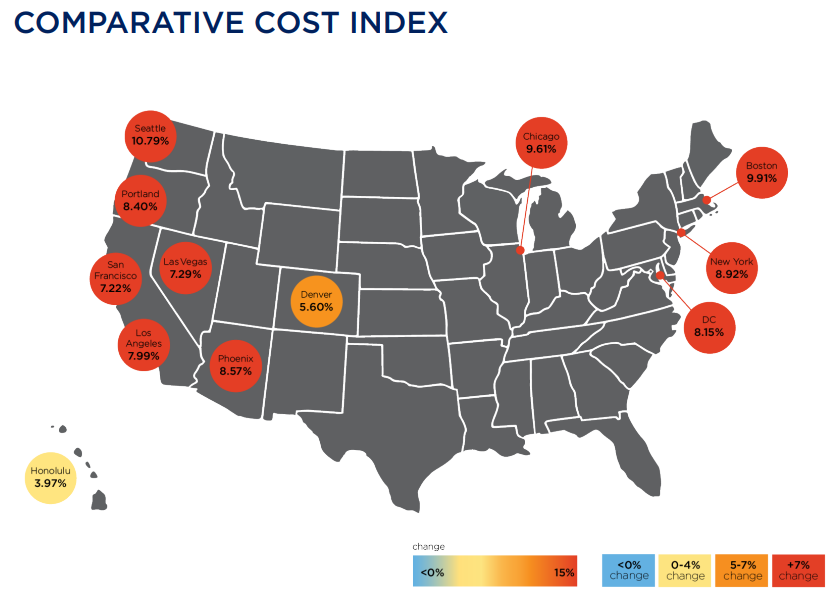
    Nationally, construction costs rose 8.04% over the course of 2021. Phoenix’s costs increased 8.57%, the fifth largest major-market increase in the country. This appears to be indicative of an overall trend for Phoenix and Arizona versus the nation as a whole.

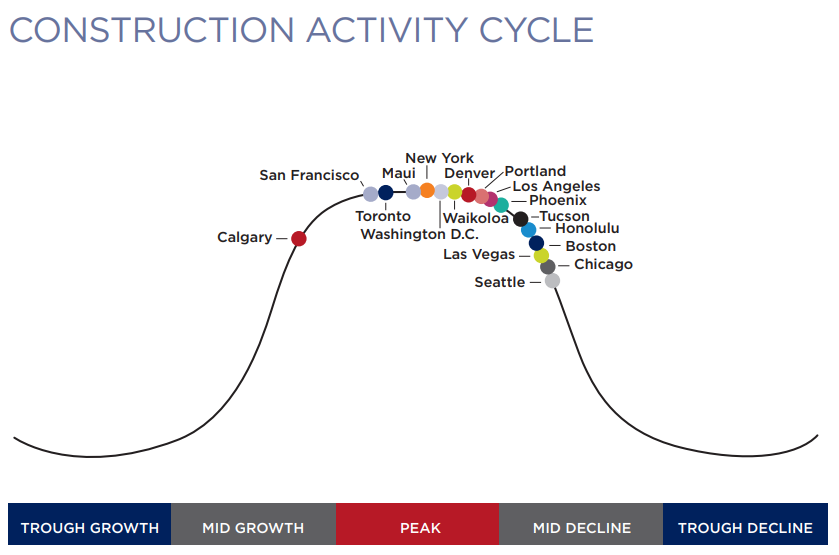
    One particular point of concern in the RLB report shows the Phoenix Construction Activity Cycle passing out of the Peak stage and entering Mid -Decline.

    As RLB North America President Julian Anderson said in the report’s overview, “The severity and duration of the economic and market fluctuations on the US economy are difficult to predict.”

    The Overall State of Economic Affairs

    After more than a decade of the Federal Reserve tending the fires of the national economic engine by tossing handfuls of thermite into the liquidity and money supply furnace, policymakers have noticed things have gotten a little too hot and embarked on an aggressive program of interest rate increases to cool things down.

    The Bureau of Labor Statistics’ Consumer Price Summary for Urban Consumers for all items in Q1 showed an unadjusted increase of 8.5% year-over-year, the largest inflation leap since December of 1981. Energy prices were up 32% for the same period.

    Of course, tossing water on a raging fire will drop the temperature, but the steam it generates brings its own sets of complications.

    On top of the Economics 101 matters, the construction industry, like every other, faces additional, co-related concerns. The supply chain shortages that preceded and were amplified by the pandemic remain unresolved. There had been some modest optimism on that front, but then Russia invaded Ukraine and worries, particularly in terms of global energy supply stability and deliveries, reaccelerated.

    On an apparent bright note, federal spending on infrastructure, most notably via the Infrastructure Investment and Jobs Act, has dramatically increased funding for highways/roads/bridges, water projects, passenger and freight rail, and public transit improvements.

    While this will undoubtedly lead to new employment opportunities, that could well exacerbate the already existing labor shortage. According to a February report from Associated Builders and Contractors, the U.S. construction industry had a deficit of 650,000 skilled construction workers.

    IIJA does have provisions to invest in workforce education, including, among others, an apprenticeship program to train 18-21-year-olds as truck drivers, which, if implemented and executed as planned, could benefit both the skilled labor and supply chain issues. However, it stands to reason that adding more jobs in the near-term, while potentially adding to the workforce in the mid- and long-term, may create more near-term pain than it alleviates.

    Since the late 1970s, national policy has pushed toward sending all kids to college, resulting in a stigma associated with work in the skilled trades and a student debt crisis totaling $1.75T and directly impacting more than 43 million Americans. It has only been in the last few years that the construction industry and a plurality of national leaders have begun orchestrated efforts to counter those impacts, and half a decade of even the most focused effort cannot made much impact on an issue going into its second generation.

    The Growth-Stagnation Paradox

    As all these issues come to a head, even the fuels that have powered the last several years of economic growth in Phoenix and similar markets threaten to burn beyond containment. Largely driven by its historically better affordability and generally business-friendly policies, companies and individuals from high-dollar, high-regulation states like California have moved to Arizona in droves, adding jobs and new capital to the overall economy. Arizona has led or been among the leaders in in-migration for the last several years, adding nearly 89,000 new residents between July 2019 and July 2020, according to the U.S. Census Bureau.

    That influx has had its share of negatives, however. First, Arizona’s housing supplies were woefully lacking even before the influx, due in large part to an understandable slowdown in deliveries during the Great Recession. The expanded and still expanding population has increased demand levels to the point that multifamily occupancy rates now routinely exceed a once considered impossible 97%.

    Second, the new arrivals are used to markedly higher residential costs than the existing population. If someone is used to paying more than $4K/month for an 850SF apartment, the Phoenix average rent of $1,550 seems like a steal. That, however, has gutted the area’s affordability as a practical matter, particularly for existing residents. Arizona is now rated the fourth-worst state in the country for affordable housing.

    Colliers reports Phoenix-area rents increased 80% between 2016 and 2021. Federal Reserve data show the area’s median household income only increased 22% during the same period. BLS data show March’s Phoenix inflation rate was 10.9%, the highest in the nation.

    Conversely, San Francisco, which leads the nation in out-migration, also had the lowest inflation rate at 5.9%.

    Adding a final note of caution to the good and impacts of Arizona in-migration is the concern that the pace of skilled job growth may outstrip the supply of skilled workers. While relocations often bring a retinue of existing workers along with them, rarely does the full staff follow the company. In addition, the host of brand-new developments and employers will need to staff from the ground up, and there are some initial rumblings that economic development officials may have done too good a job bringing new opportunities without a sufficiently skilled workforce to fill them.

    Some companies and economic development staffs are working to address the worker issue. When AZBEX broke the news about LG Energy Solution’s plans to build a massive new battery plant in Queen Creek, we reported that part of the development agreement between the company, Pinal County and the Town included employee education incentive payments of up to $3K/employee and the creation of a workforce training facility with construction and operation costs of up to $6.5M. (AZBEX, March 18th).

    Many employers, however, are not undertaking this kind of planning, and they may encounter difficulties in finding sufficient talent to fill their jobs, which could lead to a slowdown in new development and yet another supply-versus-demand conundrum.

    Prophesy is a complex and cumbersome art, and only hindsight will say whether predictions were insightful or foolish. However, as more and more investors, analysts and policymakers adopt cautious tones, both nationally and regionally, it does not take Nostradamus to understand the factors influencing the newfound sobriety of many expectations.
    Credit: Rider Levett Bucknall
    Credit: Rider Levett Bucknall
    Associated Builders and Contractors Bureau of Labor Statistics Census Bureau Colliers Construction costs Consumer Price Summary economic development economy federal reserve Great Recession housing market housing supply IIJA In-migration inflation Infrastructure Investment and Jobs Act infrastructure spending Job training labor shortage LG Energy Solution North America Quarterly Construction Cost Report recession Rider Levett Bucknall Russia-Ukraine War skilled trades student debt crisis trends
    Share. Facebook Twitter Pinterest LinkedIn WhatsApp Reddit Tumblr Email

    Related Posts

    Proposed State Budget to Cut Economic Development Programs in Favor of Tax Cuts

    May 1, 2026

    Ariz. Construction Added 2,900 Jobs in February

    April 22, 2026

    Home Builder Sentiment Dips in April

    April 22, 2026

    Leave A Reply Cancel Reply

    Our Picks

    Hearing Postponed for 146-Unit Multifamily in Apache Junction

    May 1, 2026

    New Scottsdale Airport Parking Project Raises Questions

    May 1, 2026

    Proposed State Budget to Cut Economic Development Programs in Favor of Tax Cuts

    May 1, 2026

    Arizona Projects 05-01-26

    May 1, 2026
    Stay In Touch
    • Facebook
    • Twitter
    • LinkedIn
    • YouTube
    Don't Miss
    Uncategorized

    Hearing Postponed for 146-Unit Multifamily in Apache Junction

    May 1, 20260

    By Roland Murphy for AZBEX At the request of developer Banyan Residential, the Apache Junction…

    New Scottsdale Airport Parking Project Raises Questions

    May 1, 2026

    Proposed State Budget to Cut Economic Development Programs in Favor of Tax Cuts

    May 1, 2026

    Arizona Projects 05-01-26

    May 1, 2026

    BEX serves architecture, engineering and construction firms as well as all the ancillary product and service categories that market to them. These include manufacturing representatives, public agencies and private real estate organizations, specialty subcontractors and services providers related to our industry.

    Our Picks

    Hearing Postponed for 146-Unit Multifamily in Apache Junction

    May 1, 2026

    New Scottsdale Airport Parking Project Raises Questions

    May 1, 2026

    Proposed State Budget to Cut Economic Development Programs in Favor of Tax Cuts

    May 1, 2026
    Contact Us

    Phone: 480-709-4190
    Address: P.O. Box 12196 Tempe, AZ 85284
    Email: sales@azbex.com

    Type above and press Enter to search. Press Esc to cancel.