Source: Associated Builders and Contractors
National nonresidential construction spending increased by 1.6 percent in January and is up 5.1 percent on a year-ago basis, according to an Associated Builders and Contractors analysis of data published by the U.S. Census Bureau. On a seasonally adjusted annualized basis, spending totaled a record $806.9B in January.
Private nonresidential spending rose 0.8 percent on a monthly basis and is up 0.5 percent compared to the same time last year. Public nonresidential construction spending also increased, rising 2.6 percent for the month and 12.3 percent on a year over year basis.
“Despite all the focus on the dislocating impacts of the coronavirus, construction — a key element of the U.S. economy — continues to perform,” said ABC Chief Economist Anirban Basu. “For the first time in history, the volume of nonresidential construction spending exceeded $800B on an annualized basis and now stands at an all-time high. Both public and private nonresidential construction spending expanded to start 2020, a reflection of the broader economic momentum evident over the last several years. Backlog remains healthy, according to the ABC Construction Backlog Indicator, and with the nation continuing to add jobs, there is more demand for public and private construction and additional funding resources. This is especially apparent in several infrastructure categories, in which spending growth continues to be robust due to healthier state and local government finances.”
“That said, there is no question that the coronavirus has significantly compromised both global and national economic momentum over the past two to three weeks,” said Basu. “U.S. manufacturing and shipping segments have begun to soften, with significant reductions in container volume already being reported at several major U.S. ports. While the crisis is expansive enough to potentially drive the economy into recession, the question is whether the crisis is severe enough to countervail current U.S. economic momentum.”
“At this time, it is unclear how coronavirus will affect materials prices,” said Basu. “Certain construction components, whether from China or elsewhere, may experience inadequate supply during the weeks ahead, and the more general impact will be decreased input prices due to lower demand. This is likely to be the case for a number of key commodities, including those related to energy.”

NEWS TICKER
- [October 23, 2026] - Rates and Costs Push Builder Sentiment Downward
- [October 23, 2026] - Pederson Group Proposing New Retail, Employment Project at Avondale BLVD
- [October 23, 2026] - Arizona Projects 10-23-26
- [October 22, 2026] - ASLD Sets Auction Date for Major Pinal County Industrial Site
- [October 22, 2026] - Queen Creek P&Z Recommends Rezoning for Mixed-Use Site
- [October 21, 2026] - Arizona Will Join Nevada’s Lawsuit Over Colorado River Cuts
- [October 21, 2026] - Access to Power Now Site Selectors’ Top Concern
- [October 20, 2026] - Phoenix Considering Annexation of 489-Unit Multifamily Plan Site
ABC: Nonresidential Const. Spending Up in Jan.
 By AZBEX Staff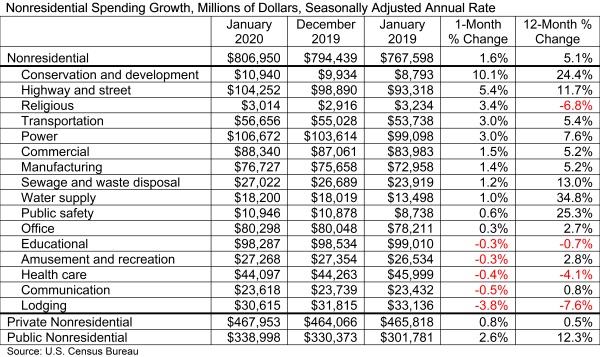
Credit: Associated Builders and Contractors