
Each year, voters are presented with the option to tax themselves to raise money for local school districts for capital expenditures, including renovations and major construction projects, new buses, technology and land purchases in the form of bond questions at the ballot. This year is no exception.
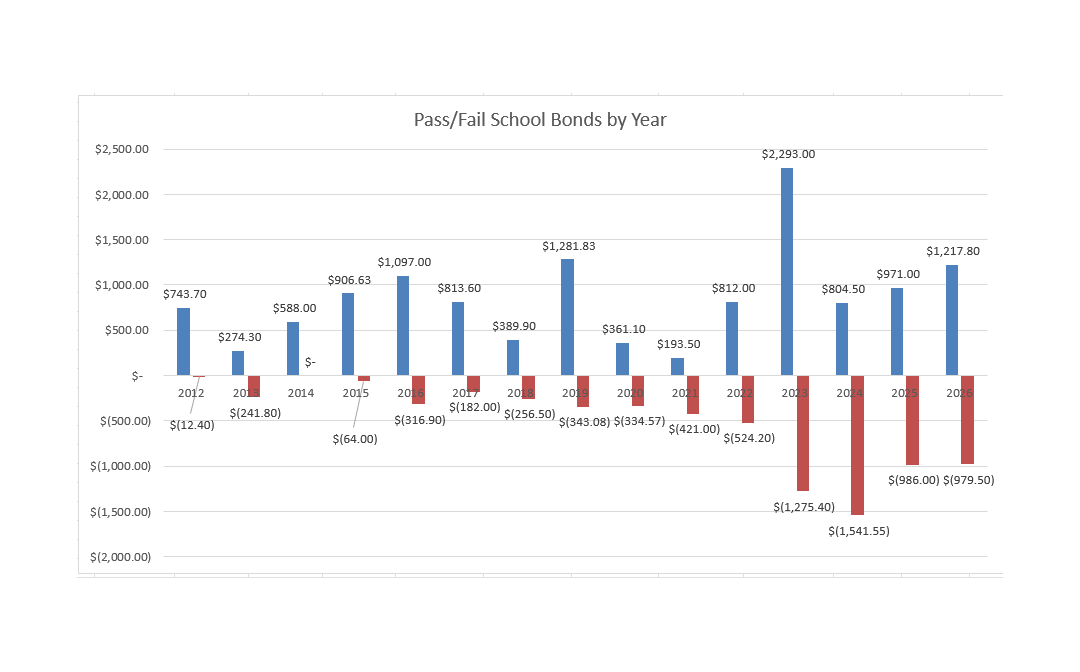
Altogether, 19 districts had bonds on the ballot in 2026. Ten are in Maricopa County, with the remaining spread across the state. Preliminary results show slightly more than half gaining voters’ approval. A total of $1.2B in bond authorizations appears to be moving forward, while nearly $1B failed to pass.
<Insert chart of pass/fail by year>
Bond Questions by District
- Mesa Unified School District did not secure voter approval for its bond as of press time. It had the largest ask of the year, with Prop 419 asking voters to approve $449M in bond authority for a wide variety of needs, including $381M in renovations to existing facilities, $45M for safety improvements and security, and $23M allocated to improvements, renovations, equipment and technology specifically for Career and Technical Education programs. The City of Mesa also asked voters for approval of a $285M bond that funds public safety and transportation. Mesa has a long history of supporting bonds at the city level, but the school district has not always fared so well. Most recently, residents voted down a $500M school bond question in 2023.
- Scottsdale USD voters are approving a request to let the district spend $375M on projects that include renovations, learning spaces, tech, safety and security, and bus replacement. Scottsdale voters have generally been supportive of school bond questions, although the most recent passage of a $229M bond was all the way back in 2016.
- Pima JTED presented a $250M bond question to voters. The district spans multiple counties, and while Pima County overwhelmingly approved the measure, the small outlying counties’ voters were not as positive. That is likely due to the concentration of how the funds will be spent, with the vast majority of the dollars going to the central campus, and only 25% being allocated to satellite campus investments.
- Tolleson Union High School District requested $250M from voters but was not successful at the ballot. “The bond measure would have funded the educational, operational, safety and facility needs of our schools,” according to the school’s bond webpage. Up until last year voters in the district had consistently supported bonds, approving $125M bond questions in 2017, 2019, 2021, and 2024 before disapproving of a $125M bond question in 2025.
- Gilbert Public Schools has requested $136M from voters to fix HVAC systems, replace roofs, improve restrooms, upgrade security, spaces for extracurricular activities, tech and approximately $6M for buses. Voters passed a $100M bond in 2019 but voted down a $100M bond question in 2023. According to voter pamphlet information, the loss of the bond dollars in 2023 has pushed out multiple facility improvement projects and deferred maintenance. As of press time, the measure is passing by approximately 700 votes.
- Phoenix Elementary School District has asked for $97.8M in bond authorization in 2026. As of press time, the measure is overwhelmingly passing, with more than 70% of votes approving the question. The funds would go toward school renovations, new gymnasiums and kitchen upgrades, among other approved uses. The district has a strong history of securing voter support, with a $97M question being approved in 2022 and a $59.5M question passing in 2015.
- Littleton Elementary School District proposed $95M in bond authorization this year but was voted down by local residents. Until this year, voters had only been asked for modest bond amounts, passing both a $15M question in 2021 and a $22.7M question in 2017. Without the bond funds, the district is likely to defer facility maintenance and expansion projects.
- Riverside Elementary School District voters have approved $85M for school facility improvements, campus upgrades and other long-term capital projects that support students and the community. Most recently, the community approved $75M in bonds back in 2020 and another $50M in 2014.
- Humboldt Unified School District in Yavapai County has asked voters to approve $79.6M in bond authorization, which is passing as of press time. The funds will go toward facilities, safety improvements, renovations, infrastructure, tech and transportation. Similar to many other lists of bond projects, common items like HVAC system replacements, roof replacements and structural repairs are planned. Voters declined to support the last bond question, denying the district a $30M funding infusion in 2020.
- Payson Unified School District was unsuccessful in its bond request in 2026; a $75M question was voted down as of press time. The funds would have gone toward traffic and circulation improvements at Payson Elementary School, repairs, renovations and improvements across the district, a new CTE shop building, cafeteria upgrades and athletic facilities upgrades throughout the district.
- Dysart Unified School District has passed $71.4M in bond funds, $45M of which will be used to build a new elementary school, as well as purchase land for a future high school. The remaining $26.4M will be distributed to various security, renovation and upgrade projects across the district. This approval is a marked change from voters’ rejection of bonds in 2025, 2024, 2019 and 2013.
- Saddle Mountain Unified School District’s $66.5M bond ask of voters is failing. The funds would have built a new middle school, in addition to the standard projects like security enhancements, technology upgrades, deferred maintenance projects and athletic field and facility improvements. This bond question rejection follows a larger $150M bond question failing at the ballot in 2025.
- Blue Ridge Unified School District in Navajo County has asked voters for approval to sell $50M in bonds. As of press time, the measure is too close to call, with only a 25-vote margin passing the question. If approved, the funds will go toward facility needs and deferred maintenance. Voters declined to support a much smaller $12M bond in 2023.
- Coolidge Unified School District in Pinal County was unsuccessful at securing approval for its $39M bond question. The largest single project in the list of proposed uses of the funds was a $4M baseball/softball complex. Voters most recently supported a $21M bond question back in 2019.
- Cottonwood-Oak Creek Elementary School District received strong support for its $30M bond question that will improve infrastructure like water and septic lines, roof replacements and HVAC replacements, security upgrades and a bus barn. This appears to be the first bond presented to voters in recent history, and more than 58% of voters supported the question.
- Prescott Unified School District is receiving approval to bond $20M for projects like roofs, HVAC system replacements, technology upgrades, security improvements, classroom renovations and new buses. The district rarely asks for voter approval of bonds. The most recent bond is dated back to 2015.
- Camp Verde Unified School District in Yavapai County secured voter support for a $20M bond question for capital improvements. The district will use the funds for expanding classrooms, school safety and security improvements, athletic facilities, technology improvements and replacing aging buses. This is the first time the district has requested bond authorization in recent years.
- Safford Unified School District in Graham County was unsuccessful in securing voter approval for its $5M bond question.
- Arlington Elementary School District secured voter approval for a $3M bond to fund building renovations and improvements, technology upgrades and new buses.
Support for K12 bond tracking continues the post-COVID trend: larger asks of voters and a much stronger propensity to disapprove such measures. BEX has been tracking bonds since 2012, and in the timeframe of 2012 to 2019, 80% by dollar volume of K12 bonds passed. Starting in 2020 and running through 2026, that volume has dropped to roughly half (50.52%).
According to a presentation by Randie Stein with Stifel at the Arizona Association of School Business Officials’ bi-monthly meeting on Nov. 4, historically, bonds had a much higher chance of passing in even years vs. odd. She also noted the much higher bond amounts since COVID, pointing to several possible reasons, including construction inflation and the lack of state-funded facilities assistance to local districts.
Stein also stressed the need for funding for school facilities has not diminished and is only growing with each year the state does not adequately fund ongoing maintenance and facilities needs.