
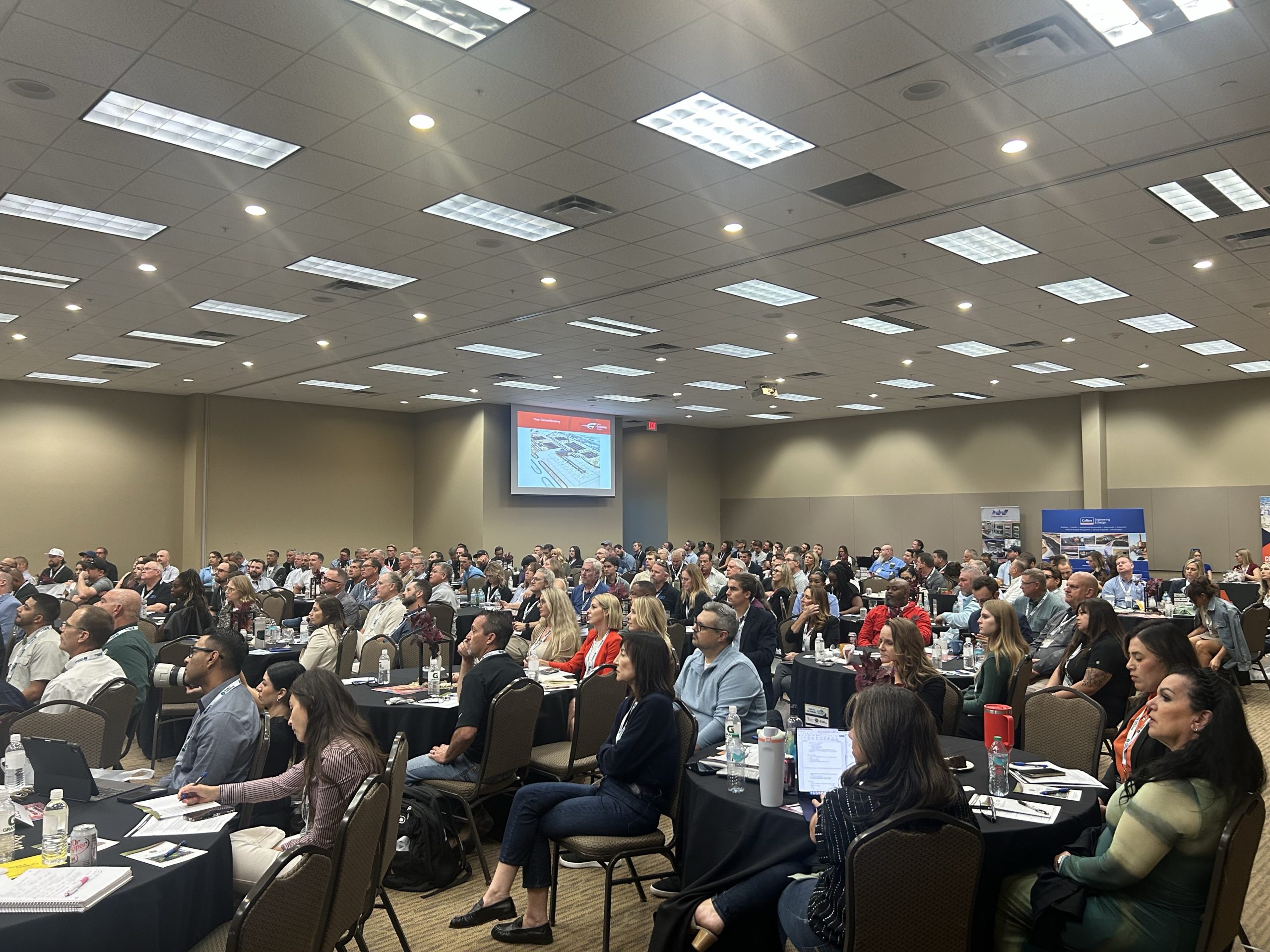
More than 250 registered attendees filled the space at the Desert Willow Conference Center this week for the BEX 2026 Public Works Conference, the annual showcase unpacking and highlighting the scale and scope of public construction and development in Arizona.
This year’s event was emceed by Carmen Ronan, director of business development for Hill International, who warmly greeted attendees, set the tone for the half-day’s discussions and got the event rolling by introducing BEX President and Founder Rebekah Morris for the first session.
As has become the norm at major BEX events, Morris led off by summarizing the state of Arizona construction with an expansive overview of the macroeconomic indicators currently influencing the industry. Among the key data points she presented:
- Largely unchanged from last year, public infrastructure projects total 22% of the overall market, versus 25% for housing and 53% for commercial;
- After turning slightly negative last year, the rate of change for statewide construction activity has returned to positive territory, with a current year-to-date increase of roughly 2.75%;
- Based on construction taxable sales data, year-to-date construction activity is $26.6B, a slight increase over 2025. Morris was quick to point out this data, while expansive, is incomplete, since data center and chip manufacturing have special carve-outs and are not included in taxable sales data, and
- Construction employment currently sits at 227,600 positions across the state. While still a solid number, Morris reminded attendees the state still has 5.29% fewer construction jobs than were reported at the all-time peak of 240,300 in 2006.
Morris’ data points and observations show population, nominal construction activity and construction employment rates of growth are slowing, and inflation has once again become a leading concern, having shown increases since April 2026.
Top CIP Markets
The centerpiece of Morris’ introduction every year is the revelation of the Top 10 Capital Improvement Plans from around the state.
While this year’s list continued to show the massive scale of public infrastructure investment across Arizona, it was a point of interest that five of the 10 leading markets showed an overall decrease in planned capital improvement expenditures, and the plans showed an overall decrease of 1.5%. Still, when the smallest of the group exceeds $1.5B, activity in the sector remains exceptionally robust.
This year’s Top 10 and their percent changes from 2025 are:
10. Chandler: $1.58B, up 6.80%;
9. Queen Creek: $1.70B, up 7.11%;
8. Tempe: $1.84B, down 5.64%;
7. Scottsdale: $1.89B, down 15.69%;
6. Pima County: $1.93B, up 4.94%;
5. Mesa: $2.37B, up 32.24%;
4. Maricopa County: $2.90B, up 10.01%;
3. Gilbert: $3.69B, down 13.29%;
2. Arizona Department of Transportation: $11.29B, down 2.37%, and
1. Phoenix: $12.86B, down 3.64%.
Points of particular interest included federal COVID-era funding, such as the Infrastructure Investment and Jobs Act, which is winding down, and nearly every municipality is implementing utility rate increases to fund new projects and expanded service capacity demands.
Also, this year’s lists showed fewer new projects than many previous years, as jurisdictions move to bring existing project plans into reality.
How Public Owners are Planning the Future
Following Morris’ review of the Top 10 plans’ highlights, Ronan welcomed the first panel of the day. Entitled, “Inside the Capital Program: How Public Owners are Planning for the Future,” the discussion was intended to explore the priorities, challenges and approaches behind long term planning and delivery.
The session was moderated by Mark Ipson, VP of Preconstruction at S&S Paving & Construction. Panelists were Lance Webb, City engineer for City of Mesa, and Riley Quinlan, deputy director of CIP for the City of Buckeye.
In his introductory overview, Quinlan talked about the massive area covered by Buckeye’s planning area and highlighted the rapid growth the city has experienced over the last several years. As an economic development reference point, Quinlan pointed out Buckeye is still only 16.5% built out, with abundant developable land still available.
Webb updated attendees on Mesa’s progress over the last year in managing CIP projects, noting $712M in project work was completed in the last year, and another 102 projects were initiated.
With the ongoing battle over planned cuts to Arizona’s allocation of Colorado River water, combined with Arizona’s continuing growth, water was a consistent point of discussion for panelists across the conference. Webb pointed out Mesa’s completion of Phase I of its Signal Butte Water Treatment Plant Expansion and the Central Mesa Reuse Pipeline Project and detailed how delivering large projects frees up the resources needed to begin the next wave.
Upcoming projects in Mesa will look at reclaimed water exchange and continue the City’s well site construction efforts.
Mesa has a history of securing voter approval of bond requests, and 2026 bond measures will address Public Safety and Transportation. There are eight projects specified in the Public Safety bond, which will provide $147.5M toward a total cost of $227.3M, and the Transportation bond addresses $134M in funding for 10 projects totaling $186.4M.
Key issues facing any jurisdiction in identifying, managing and delivering projects always include staffing, technology adaptability and cost management. Quinlan said Buckeye has increased its number of pending projects and has increased staff in project management, real estate and utilities to address them. As a more mature city more accustomed to growth, Webb explained Mesa consistently faces challenges from long-time staff members retiring or moving to other positions, but he feels the staffing levels are sufficiently stocked to manage the City’s needs.
Both panelists said their cities are adapting to the prevalence of artificial intelligence. Quinlan said Buckeye is continuing to experiment with how it leverages AI and encourages contractors to make use of the technology strategically.
Webb said Mesa is using AI for contract consistency and cost justification and has found the technology to be beneficial in those areas.
Both expressed certainty its uses and adoption will both continue to increase.
Both also said inflation is an ongoing issue that has to be incorporated into every component of project planning and execution, with Quinlan pointing out costs are now driving projects more than scheduling.
They also said they are looking beyond the standard delivery methods to help identify the best approach to minimize the spread between cost estimates and final costs. While costs and other drivers now require cities to be more selective, Webb said he had been surprised to find that in some circumstances, differences between low-bid and construction manager at risk proposals had not been significantly different.
Big Plans, Big Projects, Big Interest
The next panel looked at three major infrastructure projects that will have definite impacts on the future of life in the Valley of the Sun.
The moderator was Sabrina Perez, client development manager/Desert Southwest, at Terracon. She introduced the panel comprised of:
- Daver Malik, assistant aviation director and chief development officer at the City of Phoenix Aviation Department;
- Carmen Parks, director of engineering & facilities for the Mesa Gateway Airport Authority, and
- Paul Lopez, West Phoenix extension project manager at Valley Metro.
Malik began his presentation on the West Terminal project at Phoenix Sky Harbor International Airport by reminding attendees it is the largest project ever undertaken at the airport and might be the largest ever undertaken by the City of Phoenix overall.
Malik said the project is necessitated because current terminal and passenger service capacity at the airport is maxed out. Sky Harbor currently manages 52 million passengers per year and expects to serve 90 million by 2050. The West Terminal development will serve three key objectives: Capacity and Operational Resilience, Passenger Experience and Level of Service, and Flexibility for Airline Growth.
Before the actual terminal construction can begin in hopes of meeting its 2033 delivery target, extensive enabling work is underway to prepare the site and relocate existing facilities. Enabling work and larger procurements for the overall development are expected in 2027, and an outreach event is planned for Nov. 17.
Following Malik, Lopez then offered insights and updates on Valley Metro’s West Phoenix Light Rail Extension. Planned for delivery in 2036, the extension will start from either 19th Avenue and Camelback Road or Central Avenue and Indian School Road and extend to the Desert Sky Transit Center at 79th Avenue and Thomas Road. The line could also extend to end near the Banner Estrella Medical Center near 91st Avenue and Thomas Road.
Lopez said key considerations currently being examined include determining the extension’s origin and termination points, as well as examining whether to develop the line at grade like the current light rail lines or as a grade separated (elevated) line that will run above street level and not be impacted by vehicle traffic concerns. Another important detail yet to be established is the final construction delivery method.
Valley Metro is currently conducting public outreach for project input and is engaged in business outreach to help businesses prepare for construction impacts and changes the development will create.
Parks then presented Mesa Gateway Airport Authority’s plan for the airport’s East Side Terminal. Unlike Sky Harbor, Mesa Gateway is not yet running into capacity issues. Rather, the airport is planning for growth beyond its current service level of two million passengers per year.
Phase I of the terminal project is designed to increase capacity for service to three million passengers and is hoped to deliver in 2036. Phase II will eventually expand capacity to between five and seven million.
The airport authority is currently working with key stakeholders to identify and secure funding, support the various private economic development operations on airport land to maximize long-term land leases and activity, and continue the demand-driven planning and funding processes.
Balancing the Technology Tightrope
The fourth panel of the day was something of a departure from the strictly public infrastructure focus of the rest of the event.
Given the geometric and escalating expansion of AI and affiliated technologies into the world of Architecture/Engineering/Construction, moderator Stephanie Handley, business development director at PCL Construction, ran a panel of technology experts to provide their insights and recommendations to accommodate the trend across the construction and design world.
The panel was made up of:
- Colten Browning, COO of Hansen Consulting Group;
- Brad Thompson, VP of strategic innovation at SDB Contracting, and
- Justin Neagle, chief storyteller for Spot Migration.
While all of the panelists are staunch technologists, none of them advocated adopting a technology for its own sake and then fitting it to the company’s existing processes. There can be a rush to implement for fear of missing out or getting left behind, but Browning said while owners want to move quickly, they also want to own their processes. End users dictate what efficiencies need to be implemented.
Neagle said the experts who work in the field are often not technologically advanced. It is essential to invest in training to teach them how to perform technology-specific tasks and adapt the process to what they are already doing.
Everyone agreed the technology is only going to expand and, while that can and should be a net benefit, human oversight and control cannot and should not be done away with. Neagle said it is the human who deals with the AI result who has to vet the information and ensure its accuracy and relevance.
Browning said owners and users should always prioritize the quality of the technology’s output and implementation over its quantity. He urged implementers to be surgical, to implement guardrails for quality control and, most importantly, use humans to set the operating parameters.
He also advised owners to never implement any changes that have not come upward from the field as necessary process enhancements.
Thompson agreed, saying humans have to be involved at every stage and must be assigned the responsibility for due diligence.
Neagle stressed the importance of controlling what tools and processes are used and not allowing random one-off uses to work their way into the processes.
Projects, Priorities & Procurement: Delivering Projects While Navigating Challenges
In the last session of the day, moderator Josh Roberts, public business development manager at Advanced Drainage Systems, queried his panel of public experts from some of the area’s leading markets on their success, challenges and processes.
The panel was comprised of:
- Ryan Blair, capital improvements manager for the Town of Gilbert;
- Eric Froberg, City engineer for City of Phoenix, and
- Alison Tymkiw, senior-director/City engineer for City of Scottsdale.
After the panelists gave overviews of their projects and organizations, Roberts began the questions about the panelists’ processes. He asked them to start by outlining some of their specific key challenges.
Tymkiw said an ongoing challenge in Scottsdale is managing cost increases and adjusting priorities. She explained many of the City’s major projects in recent years came from a bond measure approved by voters in 2019. Those projects were initially cost estimated in 2017. After voters approved the measure, the COVID pandemic derailed timelines and spurred major inflation both in the construction sector and across the general economy, leading to significant increases in costs and the need to shift project priorities to meet the new reality.
Now, she said, Scottsdale has revised its processes to review project scopes and prioritization with department reviews for existing projects and to look at all projects at each phase of their progress.
Froberg said his greatest challenge is managing expectations while still ensuring effective delivery. This entails catching all departments up on guidance for general obligation bond projects and aligning resources and expertise accordingly.
Blair’s foremost ongoing concern is mitigating risks in terms of budgets, inflation and other issues. His efforts include updating costs on all 444 of Gilbert’s projects in real time to ensure accuracy and consistency.
When asked how they were managing bid prices in the current market, Blair said Gilbert is looking at different delivery methods to lower or control costs.
Froberg said Phoenix is working in a similar manner, as well as using different procurement methods as a quality check on the provider pool. He said companies that do business with the City for a long time may become comfortable, and comparing a low-bid price against a CMAR, for example, could help ensure both vendors stay lean and focused on fair and accurate pricing, a sentiment Tymkiw echoed.
Wrapping Up
The BEX Public Works Conference revolves every year around the publication and release of the centerpiece of the company’s annual public project roundup. The FY 2026-2027 CIP Special Report is now available for purchase.
This year’s report has complete, multi-year listings of current and upcoming projects from more than 30 of the top Arizona municipalities, counties and agencies. Customers who buy the report not only get the roughly 250-page finished document, they also receive a digital copy of the full project spreadsheet with notes and details on prime design firms and contractors, with highlighted CIP documents from each agency.
The report is an essential tool for companies looking to expand their presence in the public A/E/C space.
For those who were unable to attend the conference, the slide deck from the various presentations, most of which have much more detailed and expansive project lists and details than we could report in this overview, is available here.