
By Rebekah Morris for AZBEX
A pilot project has demonstrated the Integrated Design-Build contract type and alternative delivery method accelerate timelines while maintaining focus on the stated goals.
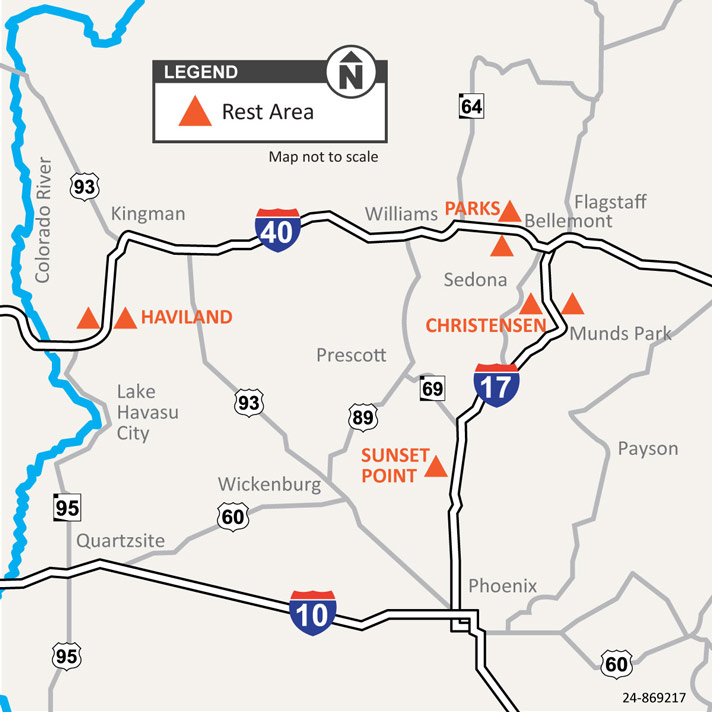
In late 2023, the Arizona Department of Transportation solicited a pilot contract type of using Integrated Design-Build (aka Progressive Design-Build) to design and build a total of seven Rest Area Truck Parking Lot Areas at four locations across Arizona. The goal of the project was to reopen shuttered truck parking at locations on Interstate 40 in Parks and on Interstate 17 in Christensen, and to provide as many new truck parking spots as possible for long-haul truckers at the Sunset Point and Haviland rest stops.
The project is nearing completion and has proven to be an example of successful delivery using this contract type. On March 31, the project team presented at the Design-Build Institute of America Pacific-Western Region Luncheon, highlighting the pros and cons, as well as lessons learned from the experience.
The project team and panelists consisted of: Myrna Bondoc, ADOT Major Projects Division Project Manager, Allen Hathcock, Design Manager for Kimley-Horn & Associates, and Grant Larson, Preconstruction Manager for Sundt Construction. The event was sponsored by DPR Construction.
What is Integrated (Progressive) Design-Build?
The concept of design-build is not new to the industry or ADOT. In fact, Arizona’s largest highway expansion projects in recent history use this contract type. These include the I-10 Broadway Curve, the I-17 Flex Lanes project and the South Mountain Loop 202 Extension.
Collectively, these projects total more than $3B in project value delivered to the Phoenix Metro in the last 15 years using this contract type, under which ADOT contracts with only one entity, comprised of the contractor and prime design firm.
Common advantages of using design-build include speed of delivery, higher quality and less risk of the final contract price exceeding the original guaranteed maximum price. Additionally, the collaborative and team approach is touted as more cooperative and generally leads to a “project-first” mentality.
On a traditional design-build project, a contract price or GMP is finalized when design is roughly 30% complete. ADOT has historically selected a design-build team using a two-step process, where the first step is the technical capabilities of the team, or the written qualifications-based step. The second step is a price competition. In theory, a highly qualified team could lose if its price is higher than a less qualified team’s.
Integrated or Progressive Design-Build is slightly different. The team is selected based on qualifications only, and multiple GMPs are established and contracted as phases progress. In this case, GMP 1 was the demolition of only two shuttered rest stops. That early GMP enabled construction to start approximately four months after the contract notice to proceed.
That speed to construction with multiple GMPs is what makes the Integrated Design-Build contract type unique. Establishing phased GMPs as the design progresses is more similar to a Construction Manager at Risk delivery method. The Integrated Design-Build contract tries to pick the best of both worlds (design-build and CMAR) to deliver a better final result.
When asked how long a project like this would take using a traditional design-bid-build contract type, Hathcock explained that with the multiple review steps, it would be roughly 18 months from NTP to design completion on just the first rest stop. The construction bid process could then begin, followed by contract negotiation, mobilization and construction. Altogether, this could have easily taken 22 months from beginning design to groundbreaking. Instead, the speed of getting underway is a distinct highlight of using this delivery method.
From kickoff to GMP execution, the three partners of Owner, Engineer and Contractor met weekly to review project details.
Innovation Enabled by Contract Type
Another key benefit of using the design-build process is the ability to bring the best ideas for the project into the room, have them thoroughly and quickly vetted by the various stakeholders, and implement them into the project.
The pilot projects’ four locations all have varied constraints to accommodate. These include availability of existing power, unique geotechnical conditions, topography and wide-ranging annual temperatures. Additionally, the sites are mostly remote and do not have a large local labor pool from which to draw trade partners.
For example, at one location, the initial design prescribed 14” of asphalt. Sundt Construction was able to look at alternatives, ultimately suggesting a permeable pavement alternative called True Grid, which consists of an interlocking grid system filled with compacted rock and gravel. This system is ideal for locations with widely varying temperatures, from snow and freezing to high summer heat.
Hathcock described a process in which the engineer would propose an idea in the routine meetings and Larson would enter the details into a live estimate, providing immediate feedback to the team on how an item’s cost compares with the current estimate.
A constant and iterative value-engineering process, an evolving “menu of options,” dynamic budgeting, a streamlined submittal process and an independent cost estimating firm working directly for ADOT ensured there were appropriate checks on pricing and no one site consumed more than its share of proportionate budget.
Bondoc described that, with multiple GMPs and an Integrated Design-Build contract, if ADOT determined any part of the project was too far out of budget, it could “offramp” and direct Kimley-Horn & Associates to take that part to 100% design and then bid out the construction services. That did not happen. Rather, Larson stated the use of the Independent Cost Estimator’s pricing was within 1% of the contractors’.
When Does Integrated Design-Build Make the Most Sense?
As with any tool in the toolbox, not all contract types are appropriate for every project. Integrated design-build worked well in this case because the project had the following components:
- A heavily involved and sophisticated owner;
- Engineers who collaborate well with contractors and are open to market innovation;
- A technically sophisticated and nimble general contractor, and
- Four disparate sites, each requiring a distinct and unique design and construction approach.
Phased GMP’s worked well for this project due to fiscal year budget constraints at ADOT as well.
What’s Next? HB 2692 Moving Toward Approval
An extension of enabling legislation for infrastructure projects to use the Integrated Design-Build contract type is currently moving through the Arizona State Legislature. House Bill 2692 enables agencies like ADOT to use Design-Build and Progressive Design-Build contract types for public infrastructure projects from the time it takes effect through Dec. 31, 2030.
The most recent action, according to Legiscan, is that HB 2692 received a second reading in the Senate after passing the House on Feb. 26.