

The Bureau of Reclamation’s announcement of its preferred operating framework for the Colorado River raised concerns among Lower Basin states beyond the potential allocation cuts that have received the majority of attention in public discussions.
Also included is a preferred operating framework for the river that shifts reservoir management to protecting Glen Canyon and Hoover dams under a prolonged drought and leaves possible infrastructure modifications up to separate engineering and environmental reviews.
The framework under the Final Environmental Impact Statement would update guidelines in two-year increments running until 2036 once the current rules expire at the end of September.
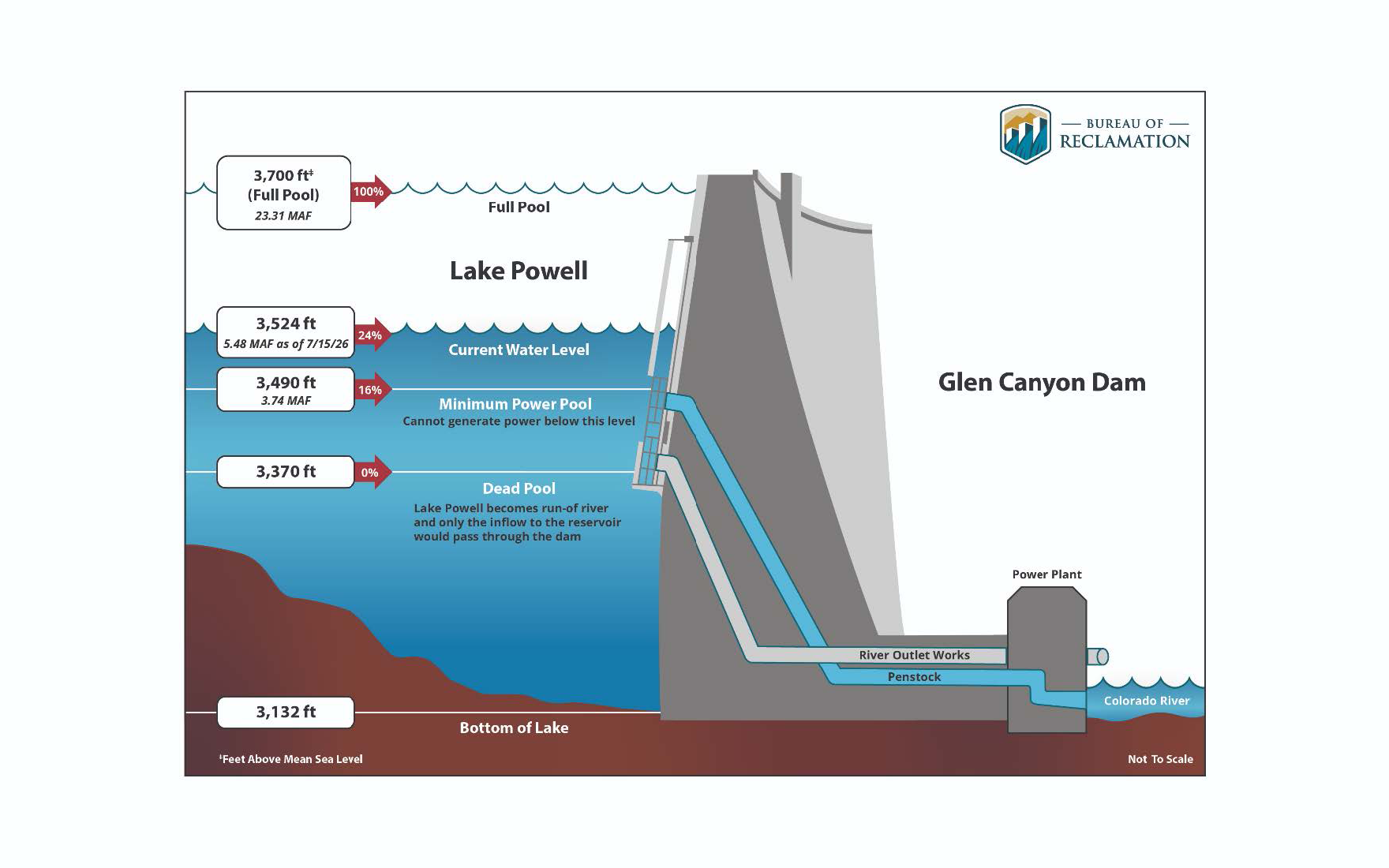
The Bureau said its approach is expected to provide greater certainty, predictability and flexibility if the seven Basin states should happen to reach a consensus on operations over the long term. The framework places particular focus on delivering reliable water supplies if Lake Powell’s water levels fall below the 3,490-foot minimum needed to consistently operate the hydropower facilities at Glen Canyon Dam.
If that happens, releases would depend on the dam’s four river outlets, not its powerplant penstocks. The outlets were not designed to handle sustained operations for low-water-level operations, the Bureau said.
The FEIS found water stored below the elevation cutoff could only be released once, since it totals less than 3.743 million acre-feet, making it untenable as a solution for long-term operations.
The Bureau acknowledges the seven Basin states have failed to reach a consensus after months of negotiations and said the environmental review addresses operational alternatives instead of imposing resolutions over disputed allocation claims. It added future guidelines will be put in place consistent with federal law.
More than 18,000 submissions were received under the Draft EIS comment period, and the Bureau says its preferred framework constitutes a middle course that considers currently authorized operations but allows flexibility if emergency hydrologic conditions arise. Under the new preferred framework, consultation would be called for if Lake Powell levels are projected to fall below 3,500 feet. Coordinated releases from reservoirs upstream would be allowed to help protect the infrastructure if needed.
Arizona, Nevada and California pressed instead for modifications to Glen Canyon Dam, rather than focusing on the limitations of the outlet works as a programmatic operational limitation. California recommended the FEIS should consider upgrades or repairs to reduce the infrastructure limitations instead of depending on reduced releases downstream.
Nevada argued for direct engineering improvements and releases from upstream reservoirs, along with implementing more Upper Basin reductions, instead of focusing mainly on reducing releases from Lake Powell.
Arizona said the Upper Basin Flaming Gorge, Blue Mesa and Navajo reservoirs should be used to protect operations at Glen Canyon Dam and to meet delivery obligations under the Colorado River Compact.
While saying it supported protecting Glen Canyon Dam, Utah argued releases from the Upper Basin reservoirs should stay within the existing framework and warned increasing federal use of the reservoirs could negatively impact Upper Basin obligations and damage Tribal water rights.
The Bureau rejected the Lower Basin proposals and claimed additional physical modifications would need additional engineering studies, funding and separate environmental reviews that were outside the consideration scope.
Glen Canyon and Hoover dams carry the Bureau’s lowest Dam Safety Priority Rating. There are no immediate concerns that need to be addressed, according to the findings. Reclamation will, however, continue to evaluate reducing risks to infrastructure, including plans to refurbish or replace hollow-jet valves at Glen Canyon Dam.
The first application under the planned framework will set preliminary operating rules for 2027 and 2028. They assume a Lower Basin shortage of 1.5 million acre-feet. Releases for Lake Powell will be based on Oct. 1 reservoir elevations, and additional reductions are possible if the reservoir approaches critical operational thresholds.
The guidelines are still subject to the upcoming Record of Decision. (Source: Engineering News Record)