

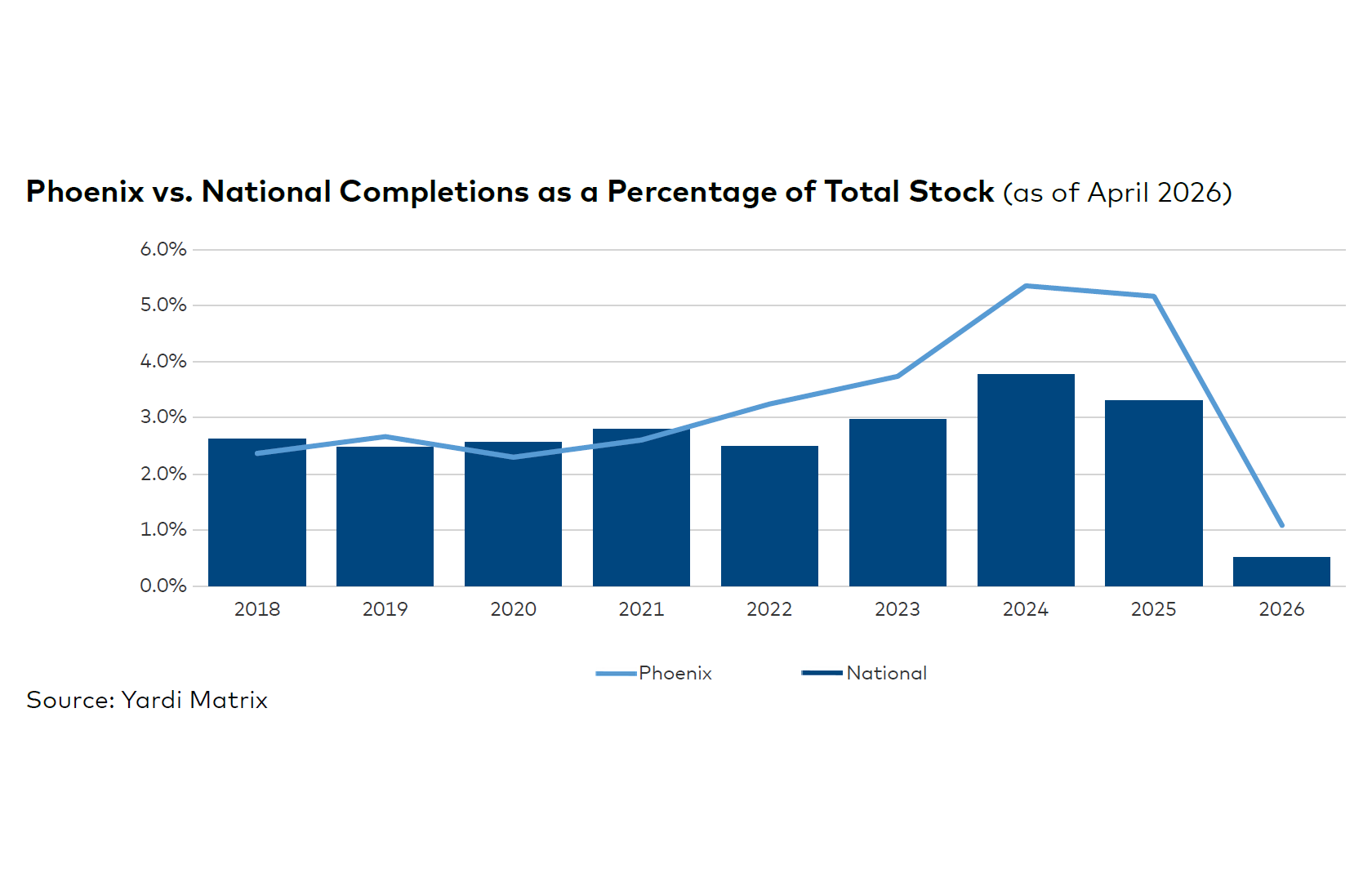

Even though the metro Phoenix Multifamily market is beginning to show signs of rent stabilization, new deliveries continue to add short-term pressure from “elevated” supply.
Despite the high pace of deliveries in recent years, the Common Sense Institute reports Arizona still faces a statewide housing shortage of 111,000 units, with the Phoenix-Mesa-Scottsdale region needing 56,000. Even with that demand in place, the rapid influx of units has caused rents to recede from their exceptional post-pandemic highs and has placed a chill on new starts as the market works to absorb them.
According to the latest Yardi Matrix Multifamily Report, “Average advertised asking rents rose 0.2%, on a trailing three-month basis through April, to $1,528, matching the U.S. gain to $1,758 and marking the metro’s first increase since May 2024. Still, rents were down 2.7% year-over-year, far steeper than the 0.2% U.S. decline, while the occupancy rate in stabilized properties slid 20 basis points, to 93.0% in March.”
The decrease places metro Phoenix among the country’s weakest performing markets, Yardi said.
Prices in the Renter-by-Necessity category were unchanged on a trailing three-month basis at $1,241, meaning the sector’s drop at the end of last year may be leveling off.
Prices for Lifestyle renters increased 0.2% to $1,725, even though higher-end apartments have a pipeline with “one of the highest completion volumes among major metros.”
Occupancies for stabilized properties dipped 20 basis points year-over-year, reaching 93.0% in March. Renter-by-Necessity occupancy was flat at 93.9%, while Lifestyle occupancy nudged downward 70 basis points to 91.8%.
Growth submarkets saw solid increases, with Queen Creek rising 2.6% to $1,744, Phoenix-East Camelback increasing 1.8% to $1,536 and Mesa-Airport going up 0.9% to $1,736. The three most expensive submarkets all experienced decreases, however. Phoenix-Paradise Valley Village was down 0.4% to $2,028; Scottsdale-North fell 1% to $1,991, and Phoenix-Downtown dropped 2.1% to $1,937.
Single-Family Rental prices continued to decrease as well, falling 4.7% YoY to $1,982. Occupancy in March was down 0.6% to settle at 93.2%.
Phoenix has seen 4,281 new units delivered through April. While the national average rate of deliveries equals 0.5% of existing stock, Phoenix’s pace yielded 1.1%. More than 75% of new units are in the Lifestyle class, with Fully Affordable accounting for 13.1% and Renter-By-Necessity comprising 1.5%.
More than 63,000 units have been delivered over the last four years, with nearly 40,000 of those coming in the last two years combined.
The area reported 25,756 units under construction across the metro, and another 100,000 in planning and permitting. Of the units under construction, 83.3% are for Lifestyle developments, while 15.1% are in Fully Affordable and 1.6% in Renter-by-Necessity.
So far in 2026, developers have broken ground on 4,222 units in 17 properties. Phoenix–Paradise Valley Village has the most new activity, with 2,295 units under construction. This point in 2025 had seen groundbreakings on 25 properties totaling 4,922 units across the metro.